TL;DR
- Most corporate culture communication lives in inboxes. Digital signage puts it where employees actually look.
- From recognition walls to live KPI dashboards, connected screens deliver the right message to the right zone without manual effort each time.
- Pickcel lets HR and internal comms teams publish, schedule, and automate content across all screens from one dashboard.
Culture is what people do when no one is watching. It is also what they see when they walk in, take a break, or move between floors.
Most internal communications budgets go toward email, Slack channels, and the occasional all-hands meeting. These are necessary. They are also ephemeral. An email announcing a new company value gets read once, filed away, and forgotten. A screen in the corridor shows that value every day, in every building, to every employee who walks past it.
Workplace digital signage has moved well beyond displaying the lunch menu and visitor check-in instructions. When deployed with a clear communication strategy, it becomes one of the most persistent and visible tools a company has for reinforcing culture at scale — and one of the few channels that reaches deskless, frontline, and non-email workers reliably.
This article covers what that looks like in practice: the content types that work, the pitfalls to avoid, and how to build a screen content strategy that actually changes what employees see and feel at work.
What Is Digital Signage for Corporate Culture?
Digital signage for corporate culture is the deliberate use of networked screens across a workplace to communicate company values, recognise employees, share organisational updates, and reinforce the behaviours and identity a company wants its people to embody day-to-day.
It is distinct from general office signage. A visitor welcome screen is functional. A display showing this month’s top performer, a live count of staff volunteer hours, or a rotating spotlight on a long-service employee contributes to culture. The distinction is intent: culture-facing content is chosen and scheduled because it shapes how people feel about where they work, not simply because it conveys operational information.
In practice, corporate digital signage for culture spans several content types: employee recognition, company values reinforcement, learning and development content, internal campaign messaging, health and safety communication, and team milestone announcements. These content types run on the same screens and the same scheduling infrastructure as operational content — no separate system required.
Why Corporate Culture Needs a Visual Communication Layer
Employee engagement sits at the centre of most HR strategy conversations, and for good reason. Gallup’s research across business units consistently finds that organisations in the top quartile for employee engagement see 23% higher profitability, 18% higher productivity, and significantly fewer safety incidents than those in the bottom quartile. The gap between an engaged and a disengaged workforce has a measurable financial cost — one Gallup analysis put the global cost of disengagement at $8.9 trillion annually.
Communication is one of the most reliable levers for engagement. Teams with the highest engagement scores receive more frequent recognition, have clearer visibility into company direction, and feel more connected to their work. None of that happens without deliberate communication infrastructure.
Where email and messaging platforms fall short is reach. A Gallagher State of the Sector report found that only 1 in 3 employees without a company email address feels adequately informed about their organisation. In manufacturing, healthcare, retail, and logistics, large shares of the workforce are deskless and may never log into an internal comms platform during a shift. Screens in production zones, canteens, changing rooms, and corridors reach those employees. A well-placed digital display is not a luxury for these environments — it is often the only reliable visual channel.
Beyond reach, screens have repetition. An email about company values is read once. A screen in the lobby shows the same message 40 times a week. Repetition is how values move from a statement on a website to a behaviour people recognise as part of how things are done here.
7 Ways Digital Signage Reinforces Corporate Culture
The following use cases reflect how HR, internal comms, and operations teams across corporate, manufacturing, and healthcare environments deploy culture-facing content on their screens. They represent the content types that create the most consistent impact.
1. Employee recognition
Quarterly performance reviews and annual awards ceremonies are insufficient recognition cadences for most workforces. Public, frequent recognition — displayed where the whole team can see it — has a stronger effect on morale and retention than private acknowledgements or infrequent formal events.
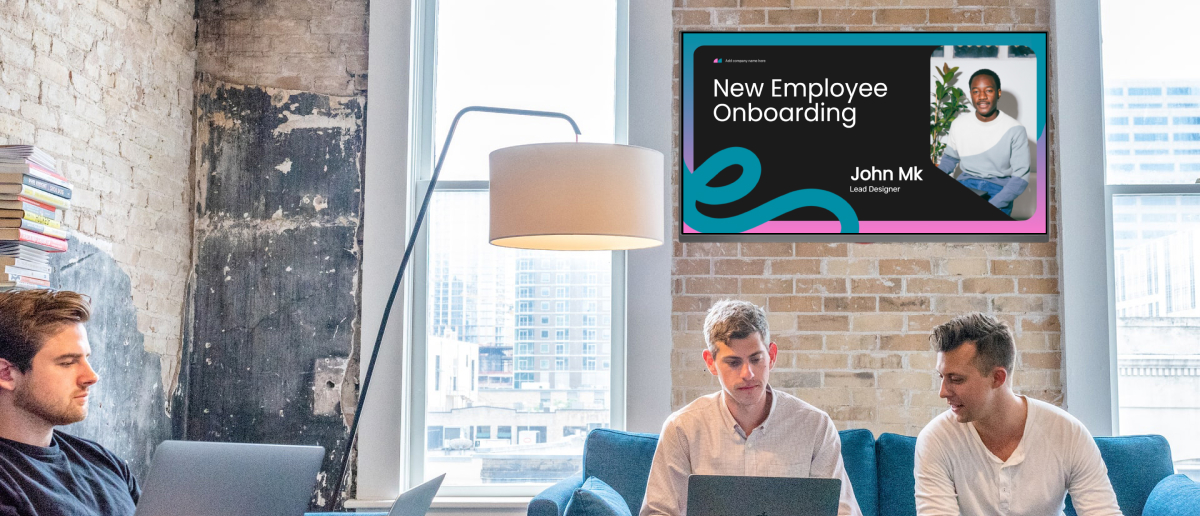
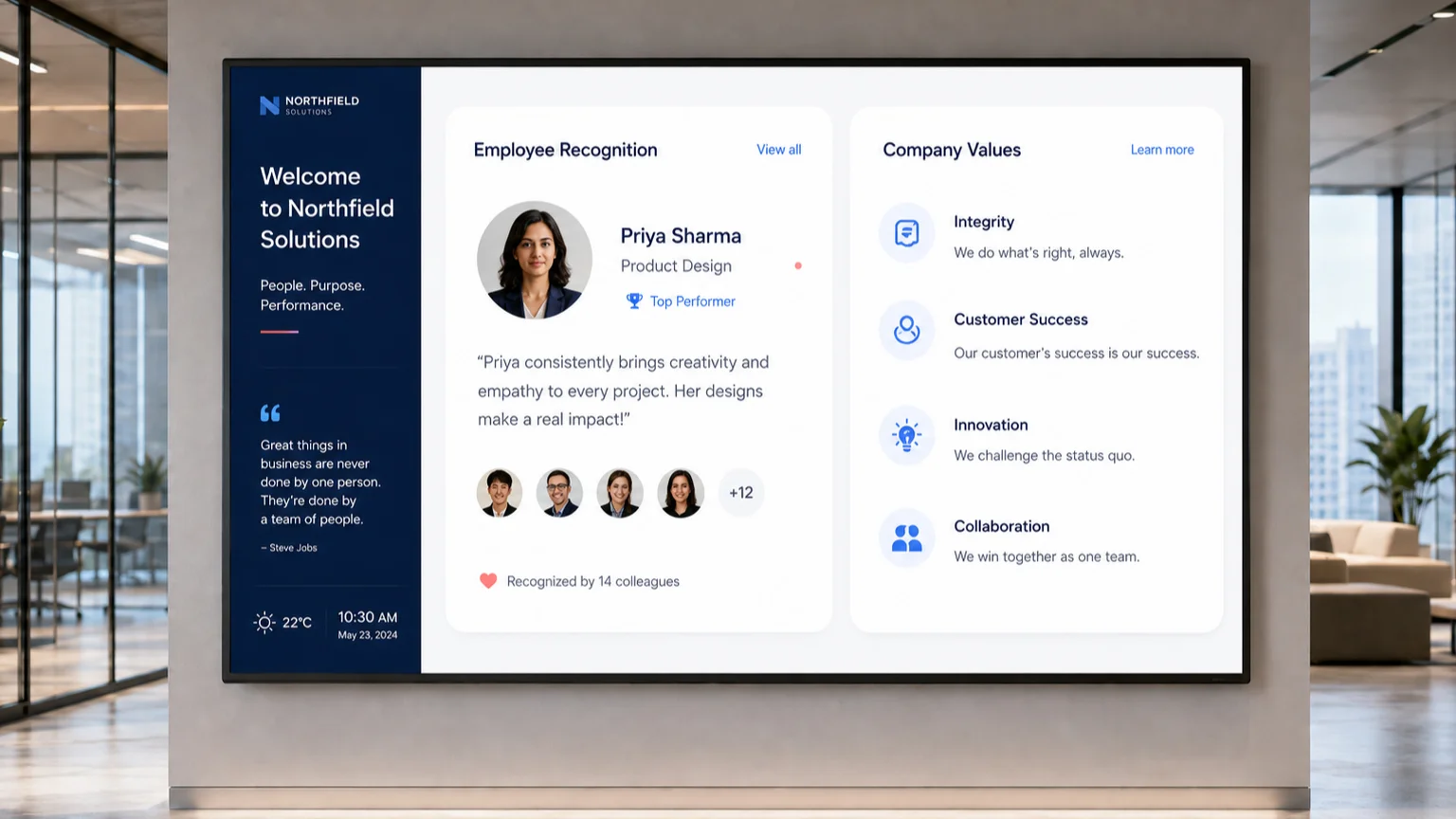
Workplace screens can display a rotating recognition wall featuring this week’s standout performer, a live tally of peer-to-peer kudos submitted through an HR platform, work anniversary milestones, or team achievement callouts tied to specific projects or KPIs. When the content updates automatically from an HR or recognition platform via API integration, it requires no manual publishing effort from the communications team.
2. Company values and mission reinforcement
Values written on a company website or framed in a reception area exist as artefacts. Values shown daily on screens throughout a building become context. Culture content that pairs a company value with a specific example of an employee living that value — a photo and a two-sentence story — is more effective than displaying the value as an abstract slogan.
Rotating content that presents one value per week, with a different example each time, ensures that the full values set gets airtime throughout the year without content becoming repetitive.
3. Health and safety communication
Health and safety protocol updates, PPE reminders, incident reporting procedures, and near-miss callouts are legally required to reach the workforce. In high-noise or deskless environments, a PA announcement or a noticeboard memo is insufficient.
Screens in production zones, warehouse aisles, and break rooms can display current safety metrics such as days without a recordable incident, reinforce PPE compliance standards, and update the workforce on any protocol change immediately — without waiting for a team briefing or a posted notice. Safety-focused digital signage also supports OSHA compliance documentation when paired with content scheduling records.
4. Learning and development content
Microlearning content delivered in 60–90 seconds fits naturally on a break-room or canteen screen. A short video on a new compliance requirement, a product knowledge flashcard, or a step-by-step process reminder for a recently updated procedure can be scheduled to play at specific times in specific zones without requiring employees to attend a training session.
In organisations using gamified learning platforms, leaderboard standings and challenge updates displayed on screens add a social dimension that drives participation. Screens create visibility for L&D programmes that would otherwise exist only inside a learning management system.
5. Internal campaigns and company initiatives
Corporate social responsibility campaigns, charity fundraising drives, sustainability reporting milestones, and diversity and inclusion initiatives need communication infrastructure to move from a policy statement to something employees feel part of. Screens that show the running total of volunteer hours logged, the progress on an environmental target, or a short profile of a team member involved in a community programme make these initiatives tangible.
Seasonal campaigns — end-of-year results, a new product launch, a site safety initiative — can be broadcast across all locations simultaneously from a single scheduling action.
6. Real-time KPIs and operational transparency
Transparency about how the business is performing is a culture driver. Employees who understand how their work connects to commercial outcomes are more likely to feel invested in them. Screens in team areas that display live sales data, production targets, quality metrics, or customer satisfaction scores give the workforce a direct line of sight to the results that matter.
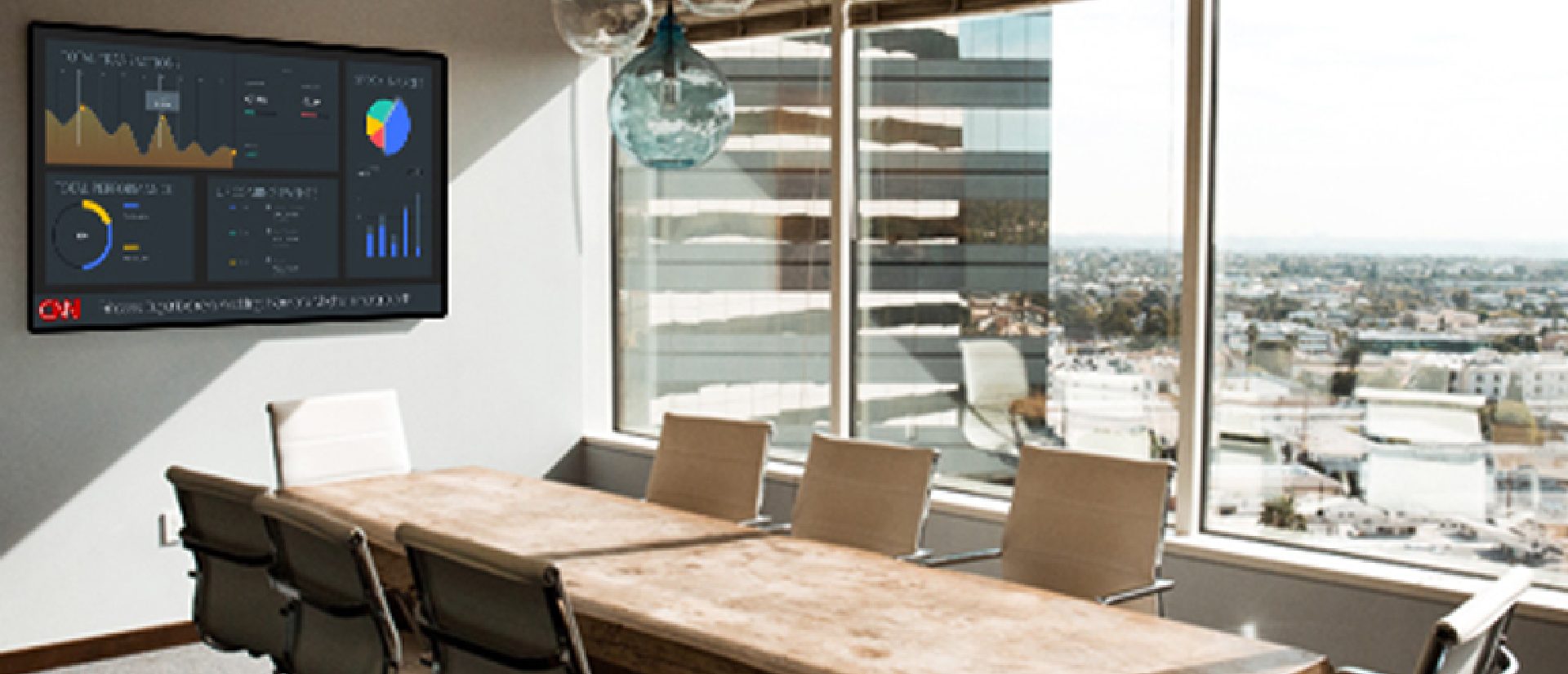
Pickcel’s integration with business intelligence tools allows live dashboards to be embedded in screen content alongside scheduled content, without requiring IT involvement in each update.
7. Communication across language barriers
In multilingual workforces, text-heavy internal communications in a single language create information inequity. Digital signage content can be produced in multiple languages and scheduled to display on specific screens based on the workforce composition in that area. Visual-first content — icons, colour coding, video without narration — is effective across language groups without translation overhead.
Pickcel’s content scheduling allows different versions of the same message to run on different screens simultaneously, making language-adapted communication operationally simple rather than a manual per-screen process.
What Good Culture Content Looks Like in Practice
The most common failure mode in workplace digital signage programmes is stale content. A screen displaying the same recognition post from two months ago, an out-of-date safety message, or a company values slide untouched since installation becomes invisible. Employees stop registering it.
Good culture content has three properties: it is current, it is specific, and it has a human element.
Current means the content reflects what is happening now. A recognition post for this week’s achievement, a safety metric for this month, a campaign that is active right now. Content teams that struggle with refresh cadence should build scheduling automations. Pickcel’s content scheduling allows teams to plan four weeks of content in a single session, with each piece set to publish and expire automatically on the dates specified — so screens never display outdated information without requiring active daily management.
Specific means the content is about a real person, a real number, or a real event — not a generic motivational message. “This month we completed 1,200 volunteer hours across six sites” is culture content. “Teamwork makes the dream work” is wallpaper. The more specific the content, the more employees see themselves reflected in it.
Human means the content has faces, names, and stories. An employee recognition post with the person’s photo and a short quote from their manager is more effective than a name on a list. A 30-second video of a team member talking about a project they are proud of lands harder than a headline about the same project.
Content length matters for screens. Full paragraphs are not read on a display. A screen slide holds 6–8 seconds of attention. Culture content should be designed for that window: one message, one visual, a maximum of two lines of text.
How Pickcel Makes Culture Communication Practical
Culture communication at scale requires a content management system that does not create more work than the communication it enables. The practical barriers for most HR and internal comms teams are time, access, and maintenance. Pickcel reduces all three.
Centralised publishing across all screens
Pickcel’s digital signage software allows any authorised team member to publish content to all screens across all sites from one dashboard. A new employee recognition post appears on every screen in the deployment within seconds of publishing, without site-by-site action or IT involvement. Permission levels allow HR teams to manage culture content independently while facilities and marketing manage their own zones.
Template-based content creation
Pickcel’s content designer includes templates for the most common culture content types: recognition posts, values cards, safety metrics, and event announcements. Teams without design resources can produce on-brand content from templates without external creative support.
API integration with HR and recognition platforms
Pickcel’s API allows content to pull live data from HR systems, recognition platforms, and BI tools. Employee of the month data, peer recognition tallies, safety incident counts, and sales performance metrics can update on screen automatically as the source data changes — without manual publishing effort from the communications team.
Scheduled playlists and content expiry
Culture content published for a specific campaign, a seasonal period, or a single event should expire automatically when it is no longer current. Pickcel’s scheduling allows teams to set start and end dates for every piece of content, ensuring that screens never display outdated information without requiring active management.
Hardware compatibility
Pickcel works with 50+ commercial display types and media players. If your offices and facilities already have commercial displays installed, Pickcel adds content management infrastructure without requiring new hardware. For new deployments, Pickcel’s device management covers screen provisioning, remote restart, and content monitoring from the same dashboard used for publishing.