Software applications that help organisations share information, coordinate work, and keep employees connected across channels, from team messaging and video conferencing to digital signage and employee surveys.
- Only 21% of employees globally feel engaged at work (Gallup State of the Global Workplace 2025)
- More than 1 in 3 internal emails goes unread (PoliteMail 2025 Internal Email Benchmark Report)
- Most organisations need 3 to 5 tools to close their communication gaps
- Digital signage, messaging, and video conferencing form the core stack for most workforces
- Pickcel serves 9,000+ businesses across 70+ countries, managing 150,000+ screens from one dashboard
When organisations struggle to communicate with their people, the cost compounds quietly. Gallup’s State of the Global Workplace 2025 report found that only 21% of employees globally feel engaged at work, a multi-year low that researchers consistently link to poor communication from leadership and across teams. Understanding how digital signage improves employee engagement can inform which communication channels to prioritise.
The problem for most organisations is not that communication tools do not exist. It is that the tools they have do not reach everyone. A chat app that desk-based employees use every hour goes unseen by warehouse teams. A company email that reaches every inbox goes unopened by a third of recipients. A poster in the break room stays up for six weeks after the policy it references has changed.
This article covers 12 categories of internal communication tools and platforms, with one recommended tool per category. Whether you are rationalising a fragmented stack or choosing tools for the first time, this guide gives you a practical framework for the decisions ahead.
If you are shortlisting vendors, see our best employee communication software compared for a side-by-side look at seven platforms.
For a broader map of every team-level platform on the market, our team communication tools guide covers the full category landscape alongside selection criteria for each use case, from digital signage and instant messaging to employee surveys and project management tools. If you are comparing employee communication software platforms side by side, the dedicated comparison covers the top 7 platforms in one table.
What are internal communication tools & why you need them?
The defining characteristic of internal communication tools is that they are designed for employee audiences, not customers. They prioritise reach, reliability, and clarity over acquisition metrics.
Why the need is more urgent now: PoliteMail’s 2025 Internal Email Benchmark Report, which analysed over four billion internal emails across organisations worldwide, found an average employee open rate of approximately 64%. That means more than one in three internal emails goes unread. For routine updates, that is an inefficiency. For safety alerts, policy changes, or operational announcements, it is a risk.
With a strategic workplace communication system, you can overcome challenges easily. And to do that seamlessly, you require internal communication tools that best suit your work preferences and employee interests. For a focused definition of what is an employee messaging system and how it differs from general internal communication tools, see our dedicated guide, which covers deployment models, workforce coverage, and platform evaluation criteria.
Effective internal communication tools close that gap by distributing messages across multiple channels simultaneously, meeting employees where they already are rather than asking them to come to a central location.
The second reason organisations invest in these tools is consistency. When the same message reaches every site, every shift, and every team at the same time, managers spend less time relaying information and more time on the work itself.
Internal Communication Tools vs. Platforms vs. Software: What’s the Difference?
The three terms are used interchangeably in most vendor marketing, but each implies a different scope of capability and a different type of buying decision.
Internal communication tools are point solutions. A team messaging app, a digital signage platform, a pulse survey tool: each is built around one channel or one function. Point solutions are easy to deploy and budget for, and the best ones do their job exceptionally well. The trade-off is that they do not talk to each other by default. Managing five separate tools means five separate dashboards, five logins, five renewal cycles, and five sets of analytics that do not add up to a single view of how well your organisation communicates.
Internal communication platforms are integrated systems that bring multiple functions together under one interface. Microsoft 365, Google Workspace, and purpose-built internal comms platforms all take this approach. The benefit is reduced context-switching and simpler administration. The trade-off is that integrated platforms tend to be broader rather than deeper: their messaging feature may not match the best dedicated messaging tool, and their survey module may not match a specialist employee listening platform.
Internal communication software is the catch-all. In procurement language, it means any digital product designed to help organisations communicate with employees. When a buying guide or analyst report uses this term, it typically refers to the market as a whole, not a specific product type.
For organisations building a communication stack, the practical distinction is this: start by identifying your communication gaps (which employees do you consistently fail to reach, and through which channels). If one tool closes that gap, you need a tool. If the gaps span three or four channels, you need a platform or a deliberate combination of best-of-breed tools with clear ownership for each.
Types of internal communication tools
Internal communication tools serve distinct needs based on timing, location, and intent: some enable real-time conversation, others broadcast to shared screens, and others collect structured employee feedback. No single tool covers all 12 categories effectively.
The starting point for choosing is always your workforce composition and your biggest communication gaps, not a vendor features list. Organisations with deskless workers or multiple locations typically need different tools than desk-based-only teams.
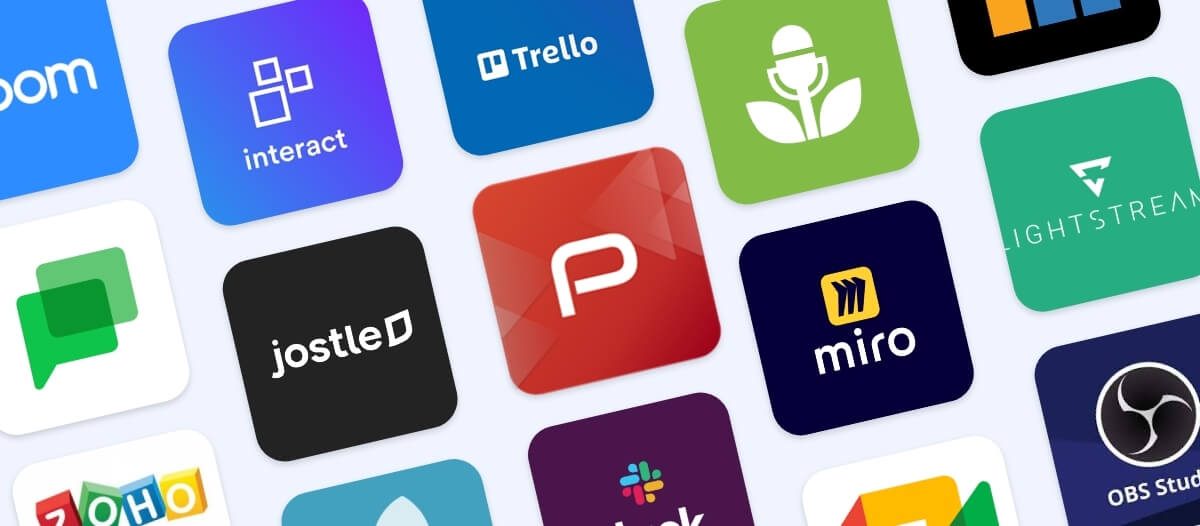
12 Internal Communication Tools at a Glance
| Tool | Category | Best For | Free Plan | Capterra Rating |
|---|---|---|---|---|
| Pickcel | Digital Signage | Multi-location visual communication | Yes | 4.7/5 |
| Google Chat | Instant Messaging | Teams already on Google Workspace | Yes | 4.5/5 |
| Slack | Team Collaboration | Remote and hybrid teams | Yes (limited) | 4.7/5 |
| Zoom | Video Conferencing | All-hands meetings and training sessions | Yes | 4.6/5 |
| OBS Studio | Video Broadcast | Live internal video and screen recording | Yes (open-source) | 4.7/5 |
| Jostle | Employee Social Network | Company culture and peer recognition | No | 4.5/5 |
| ClickUp (formerly Qatalog) | Intranet & Knowledge Management | AI-powered knowledge management and workflows | Yes | 4.6/5 |
| Stormboard | Digital Whiteboards | Visual collaboration and brainstorming | Yes | 4.5/5 |
| Zoho Projects | Project Management | Team task tracking and milestone reporting | Yes | 4.5/5 |
| ContactMonkey | Employee Newsletters | HR and internal comms email campaigns | No | 4.5/5 |
| Microsoft Viva Glint | Surveys & Feedback | Employee listening and engagement tracking | Requires M365 | 4.6 |
| Buzzsprout | Employee Podcasts | Audio content for distributed teams | Yes | 4.8/5 |
Note for content team: Pickcel Capterra rating updated to 4.7/5 (April 2026). Verify remaining 11 tool ratings against current Capterra listings before publishing.
12 Best Internal Communication Tools & Platforms
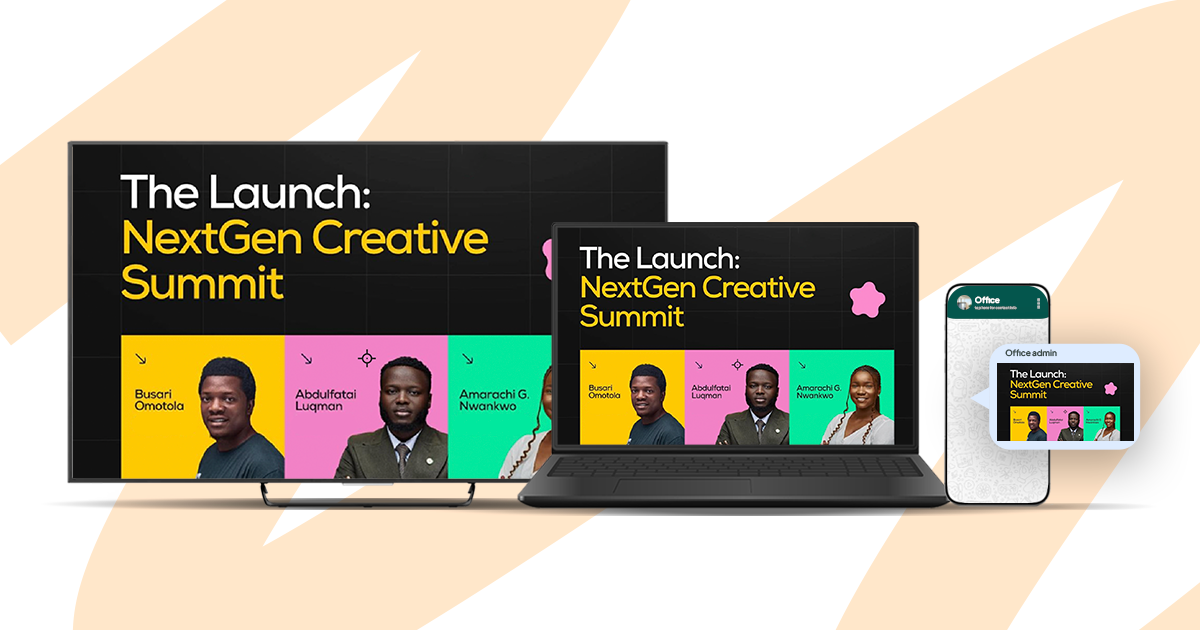
Digital signage is the internal communication channel that reaches employees without asking anything of them. No login. No notification. No device to check. A screen in a break room, on a factory floor, in a reception area, or outside a meeting room broadcasts information to everyone who passes, continuously.
Pickcel is a cloud-based digital signage platform used by 9,000+ businesses across 70+ countries to manage 150,000+ screens from one dashboard. For internal communications, it addresses the core problem that other communication tools do not: reaching employees who are not at a desk and not checking their phones during a shift.
One of the key feature of Pickcel is Emergency alerts. Emergency alerts can be sent across multiple office locations and premises using the Pickcel digital signage solution. All you have to do is update the emergency notice on the dedicated app and hit the publish button. This widespread communication tool can ensure safety without any panic or havoc. For structured, pre-written free IT outage notification templates covering network outages, system failures, and maintenance windows, see our dedicated template library for IT communications teams, which includes screen-ready, email, and SMS formats for every major incident type
- Publish content to all screens simultaneously from one browser tab, in real time
- Multi-zone layouts: display a live KPI dashboard, a team announcement, and a safety reminder on the same screen at the same time
- Audience targeting: send different content to different locations, floors, or departments without separate logins
- Emergency alerts: override any scheduled content instantly with a priority message
- Integration with Google Sheets, RSS feeds, social media, and internal data sources
- Offline playback: screens continue to display the last scheduled content when internet is interrupted
- Security: SOC 2 Type II and ISO 27001 certified
Best for: Manufacturing plants, logistics centres, retail branches, healthcare facilities, and any organisation with deskless workers or multiple locations.
Pickcel's multi-channel employee communication platform extends beyond digital screens to deliver messages across eight channels from a single dashboard: digital screens, desktop screensavers, scrollers, wallpapers, priority desktop alerts, Microsoft Teams, WhatsApp, and SMS. No app installation is required; messages reach employees automatically on devices they already use.
Pickcel reports that organisations consolidating fragmented communication tools onto its platform achieve a 60 to 75% reduction in tool costs and a 75% reduction in admin time for communications managers. For organisations with deskless workers, a segment estimated at 2.7 billion globally (Emergence Capital, 2018), the platform's passive delivery model closes a gap that app-dependent tools cannot. For organisations building a deskless-first stack, communication solutions for deskless workers covers the full toolset. See the full capability set on the Pickcel employee communication app page.
Instant messaging closed the gap between email (formal, slow) and phone calls (interruptive, unrecorded). For desk-based teams, it is now the primary channel for quick questions, status updates, and asynchronous conversation that does not need a meeting.
Google Chat is a strong choice for organisations already using Google Workspace, because it is built into the same environment as Gmail, Drive, Docs, and Calendar. This eliminates context-switching for the most common workplace tasks.
- Direct messages and group spaces (the equivalent of Slack channels)
- Threaded discussions within spaces, so conversations stay organised by topic
- Integration with Google Meet for instant video escalation
- File sharing via Google Drive without leaving the conversation
- Searchable message history
- @mentions and smart suggestions powered by Google AI
Best for: Teams that run their daily work in Google Workspace.
Where Google Chat is optimised for Google Workspace users, Slack is channel-based and integrates with almost everything else. It has become the standard for remote and hybrid teams precisely because it is integration-agnostic: over 2,600 apps connect to Slack, from project management tools to CRMs to custom bots.
- Channels organised by team, project, or topic
- Pinned messages for reference content that new team members need immediately
- Audio and video clips inside conversations, for asynchronous communication that does not need a call
- Huddle calls with screen sharing for quick synchronous collaboration
- Workflow automation via Slack's built-in workflow builder
- Search across all messages and files
Best for: Remote-first or hybrid teams that use multiple SaaS tools and need one integration hub.
The all-hands meeting, the town hall, the manager one-on-one: these formats did not disappear when teams went distributed. They shifted to video. Zoom became the default precisely because it works reliably across devices, operating systems, and network conditions.
- Video meetings for two participants or 1,000+
- Host controls: manage who can speak, share screen, or turn on video
- Breakout rooms for small group discussions within a larger session
- Whiteboard sessions integrated into meetings
- Recording and transcription for post-meeting reference
- Integration with Google Calendar, Microsoft Outlook, and Slack for scheduling
Best for: Town halls, training sessions, management briefings, and any organisation that needs to bring distributed teams face-to-face at scale.
Video broadcast differs from video conferencing in one important way: it is one-to-many rather than many-to-many. An organisation might use video broadcast for a CEO's quarterly message, a product launch presentation, or a safety training session where most participants need to watch, not interact.
OBS Studio (Open Broadcaster Software) is an open-source platform for screen recording and live streaming. It is more technically involved than consumer tools but offers far more control over audio, video, and output quality.
- Scene-based recording: switch between layouts (presenter, slides, demonstration) during a broadcast
- Audio mixing and noise suppression
- Live streaming to YouTube, internal platforms, or any RTMP destination
- Plugin ecosystem for additional capabilities
- Multi-source input: webcam, screen capture, external camera, microphone
Best for: Organisations that produce regular internal video content and have a team member comfortable with audio-visual software.
A company intranet handles information. An employee social network handles belonging. These are different problems. Jostle is built for the second: it gives employees a space to share achievements, recognise colleagues, participate in company culture initiatives, and stay connected to the organisation's identity, not just its operations.
- Announcements and achievements feed, separate from project work
- Targeted messaging to specific teams, departments, or locations
- Polls and feedback tools built into the social feed
- Article publishing and content curation
- Employee recognition features, including peer-to-peer shoutouts
- Directory and org chart for workforce navigation
Best for: Organisations that have struggled with low participation on existing intranets, or those where culture and recognition are a strategic priority.
The challenge with most intranets is that information goes in and is never found again. Qatalog approached this differently: connecting tasks, goals, documentation, and people into a single searchable layer over the tools an organisation already uses. In November 2025, ClickUp acquired Qatalog and integrated its core technology, the ActionQuery AI engine (a permission-aware enterprise search system), directly into ClickUp's work platform. Organisations that evaluated Qatalog as a standalone product should now consider ClickUp as the primary path to these capabilities.
The strategic logic of the acquisition is that knowledge retrieval and task execution belong in the same environment. ClickUp users can now surface information from any connected app without switching tools, with search results scoped to what each user is permitted to see.
- AI-powered enterprise search across all connected tools, powered by Qatalog's permission-aware ActionQuery engine
- Centralised workspace connecting tasks, goals, and documentation
- Org charts and team directories
- Onboarding and offboarding workflow management
- Integration with Google Drive, Slack, GitHub, and other common tools
- Searchable knowledge base spanning connected apps without leaving ClickUp
Best for: Teams whose information is scattered across too many systems, and organisations that want AI-assisted knowledge retrieval built into the same platform they use for task and project management.
When a communication challenge requires collective thinking rather than information broadcast, digital whiteboards bring the physical workshop experience to distributed teams. Stormboard is structured for facilitated sessions: it is not just a blank canvas, but a framework for capturing ideas, organising them, and turning them into actions.
- Sticky notes, files, images, and templates on a shared canvas
- 250+ pre-built templates for common workshop formats (retrospectives, brainstorms, planning sessions)
- Task assignment from within the whiteboard
- Mobile access for participants joining from different devices
- Infinite canvas for large sessions with many participants
- Commenting and voting on ideas
Best for: HR teams running engagement workshops, project teams running retrospectives, and cross-functional groups that need structured ideation sessions.
Project management tools serve an internal communication function that is easy to underestimate: they make the state of work visible to everyone on the team, without requiring a status meeting. When tasks, deadlines, and dependencies are tracked in one place, the "what is happening with X?" question has an answer that does not require a person to provide it.
Zoho Projects is a capable, cost-effective option that covers the core project management requirements without the learning curve of enterprise-grade tools.
- Milestones and task breakdown with subtask support
- Recurring tasks for operational workflows
- Interactive forums and in-app chat rooms for project communication
- Gantt charts for dependency and timeline visualisation
- Automation blueprints for recurring processes
- Reporting dashboards for project health and team workload
Best for: Small to mid-sized teams that want project management without the cost or complexity of tools built for enterprise PMO functions.
Despite the limitations that email benchmarks reveal, the internal email newsletter remains the most common format for formal company communications: policy updates, leadership messages, benefits announcements, and monthly round-ups. The problem is that most organisations send these from a standard email client with no visibility into whether they were read. You can now trade in those emails for company-centric newsletter tool that is purpose-built for HR and comms teams. For a focused review of the best internal communications email software and when a dedicated email platform outperforms a general newsletter tool, see our comparison guide.
ContactMonkey is an internal email tool built specifically for HR and internal comms teams. It adds tracking, targeting, and template management on top of Outlook and Gmail, without asking employees to use a new platform.
- Drag-and-drop email builder with mobile-responsive templates
- Open rate, click rate, and read time tracking per employee (anonymised or named, depending on settings)
- Audience targeting by department, location, or employment type
- Integration with Outlook and Gmail: employees receive emails in their normal inbox
- Pre-scheduled send for time zones and shift patterns
- Feedback collection embedded directly in the email
Best for: HR teams and internal comms managers who want to understand whether their email communications are actually reaching and engaging employees.
Employee feedback is only useful if it is structured, timely, and acted on. Pulse surveys (short, frequent questionnaires sent to all or part of the workforce) have become the standard approach for organisations that want to monitor engagement without waiting for an annual review cycle.
Microsoft Viva Glint (formerly Glint, acquired by Microsoft) is an enterprise-grade employee listening platform built into the Microsoft 365 environment. It combines pulse surveys with broader engagement measurement and connects findings to manager actions.
- Configurable pulse surveys measuring satisfaction, engagement, and culture metrics
- Anonymous feedback collection, with confidentiality thresholds that prevent identification
- Manager-level dashboards showing team results separately from company averages
- Suggested actions for managers based on survey results
- Integration with Microsoft Teams for distributing surveys and sharing results
- Longitudinal tracking to show engagement trends over time
Best for: Organisations with a Microsoft 365 investment that want employee listening built into the same environment as their other tools.
The employee podcast is a format that suits a specific communication challenge: long-form leadership communication that employees can consume in their own time and on their own terms. For deskless workers, commuters, or employees in roles where screen time is limited, a 20-minute audio format from the CEO or department head can reach people that a written update would not.
Buzzsprout is a podcast hosting platform that simplifies the production and distribution of audio content. It is not designed specifically for internal communications, but its ease of use makes it a practical choice for organisations new to the format.
- Automatic episode optimisation (normalisation, ID3 tagging, transcription)
- Scheduling for consistent release cadences
- Pre-roll and post-roll audio notifications (for intro/outro segments)
- Automatic transcription for accessibility
- Multi-contributor access for episodes with multiple hosts or guests
- Distribution to major podcast platforms; for truly internal content, a private RSS feed is the better option
Best for: Organisations with a communications leader or executive who communicates well in conversation, and who has consistent content to share with the workforce.
How to Choose the Right Internal Communication Platform
Choosing internal communication tools is easier when you work backwards from the communication gaps, not forwards from feature lists. Here is a practical four-question framework.
1. Who are you consistently failing to reach?
Desk-based employees are generally well-served by email, chat, and video conferencing. The harder problem is deskless workers: factory teams, retail staff, drivers, healthcare workers. If this group is your gap, digital signage and text-based alert tools should be your first investments, not your last.
2. Which channels do your employees already trust?
Changing communication habits is hard. If your workforce reads the company email newsletter, improving that newsletter is faster and cheaper than launching a new platform. Identify what already works before adding new tools.
If you are building a broader plan, our internal communication strategy guide covers the full 2026 framework.
3. What does your IT environment support?
Security, SSO compatibility, and device management requirements narrow the field significantly for enterprise buyers. Tools that are SOC 2 Type II and ISO 27001 certified reduce the IT approval cycle. Tools that require device enrollment on personal phones often fail at deployment.
4. What is the minimum set of tools that closes your gaps?
Research on communication stack complexity suggests that adding tools beyond the core set your employees actively use creates confusion rather than connection. For most organisations, three to five communication tools, each genuinely used by most of the workforce, outperforms eight tools with fragmented adoption.
Pickcel's approach to this is to act as the always-on broadcast layer: content that reaches every screen, in every location, without requiring employees to do anything. Then other tools (messaging, video, intranet) serve the audiences and contexts they are best suited for.
For a practical roadmap on closing communication gaps across your organisation, see how to improve internal communications.
Frequently Asked Questions
What is the best internal communication tool?
What are the types of internal communication tools?
What is the difference between internal communication tools and platforms?
How do I choose the right internal communication platform for my organisation?
Is digital signage an internal communication tool?
How many internal communication tools does a company need?
Reach Every Employee. Every Screen. Every Location.
Join 9,000+ businesses using Pickcel to deliver real-time updates across 150,000+ screens worldwide. No app download. No login. No missed message.