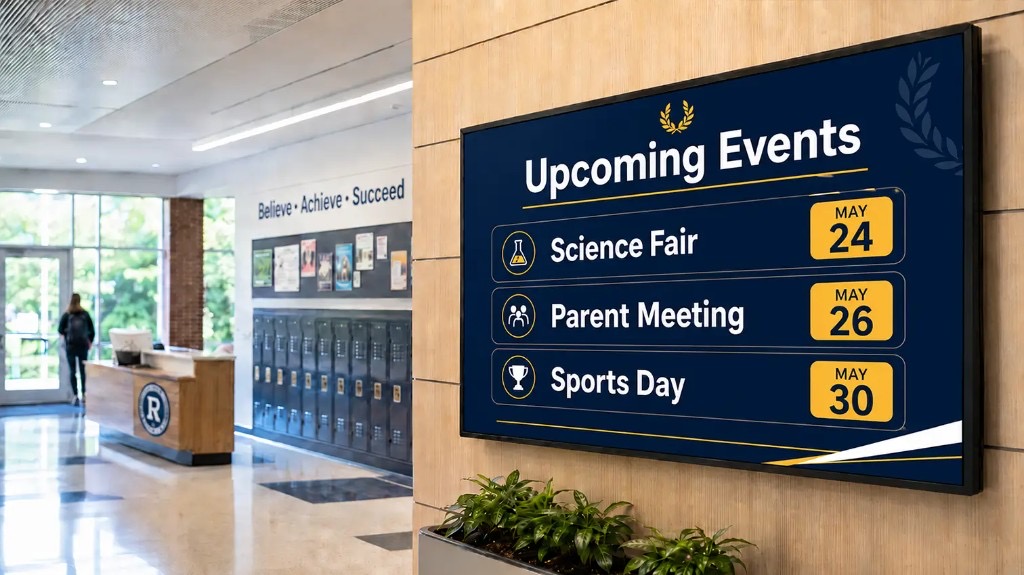
Today’s digital era has had educational institutions looking for innovative methods to enhance and improve teaching and learning experience. Creating an engaging, informative, and technologically forward environment is increasingly crucial for schools and educational institutions. Pickcel’s educational digital signage software for K-12 and universities is built around exactly this shift, covering everything from classroom displays to campus-wide wayfinding. To help with this, the use of digital signage plays a pivotal role. This comprehensive guide explores the best digital signage options for educational settings, outlines the criteria for selecting the right digital signage, details the benefits of integrating digital signage into schools, and explains how it enhances the teaching and learning experience.
Choosing the best digital signage for schools
When selecting digital signage for educational institutions, several factors should be considered to ensure the solution meets the specific needs of the school. Here’s what to look for:
1. Ease of use
The Digital signage software should be intuitive and user-friendly, allowing educators and staff to update and manage content without requiring extensive technical knowledge.
2. Content management
Look for systems that offer flexible content management options, enabling the display of a variety of media types (e.g., videos, images, documents) and the scheduling of content.
3. Hardware compatibility
Ensure the digital signage solution is compatible with the hardware you plan to use, whether it’s screens already owned by the institution or new displays being considered for purchase.
4. Scalability
The chosen solution should be scalable, allowing for easy expansion as the institution’s needs grow. This could mean adding more screens or integrating with other systems.
5. Interactivity
Interactive digital signage can enhance learning by engaging students in interactive content, such as quizzes, games, and learning modules.

6. Cost-effectiveness
Consider the total cost of digital signage ownership, including initial setup costs, software subscriptions, and maintenance. Look for solutions that offer great value without compromising on quality and functionality. Schools with limited budgets can also explore the free digital signage options for budget-conscious schools before selecting a paid tier. The guide covers available free plans and how to evaluate them against institutional requirements.
7. Security and reliability
The system should be secure to protect sensitive information and reliable to ensure consistent operation without frequent downtime.
Read more: Are digital and electronic signage the same?
Making teaching and learning enjoyable with digital signage
Digital signage has transformed teaching and learning by making them more interactive, engaging, and fun. Here are several ways digital signage is enhancing the educational experience:
1. Interactive learning
Interactive digital signage supports active learning through touch screens and interactive content, making learning more engaging for students.
2. Visual learning
The ability to display high-quality images, videos, and animations helps cater to visual learners and can simplify complex concepts, making them easier to understand.
3. Real-time information
Digital signage can provide real-time information and updates , keeping students informed about world events, weather, and other relevant topics, thereby broadening their knowledge base.
4. Collaborative projects
Screens can be used to showcase student projects and presentations, fostering a sense of community and collaboration among students.
5. Gamification
Integrating game-like elements into learning through digital signage can make gamification in education more enjoyable and increase student motivation.
6. Accessibility
Digital signage can be tailored to meet the needs of all students, including those with disabilities, by incorporating digital signage accessibility features such as text-to-speech, large fonts, and high-contrast visuals.
7.Feedback and recognition
Displaying student achievements and providing instant feedback on quizzes or polls via digital signage can boost student morale and encourage a healthy competitive spirit.
Check out: Best school digital signage companies
How is digital signage transforming education?
Digital signage offer dynamic ways to communicate, educate, and engage students and staff alike. From elementary schools to universities, digital signage is revolutionizing communication, engagement, and information dissemination within educational settings especially when schools focus on strategies to improve digital signage performance .
For higher education institutions specifically, our page on digital signage for universities covers campus-wide deployment, student engagement applications, and integration with university information systems.

Read on, to understand how some of the best digital signage help the education industry:
- Enhancing communication
Digital signage serves as a dynamic platform for disseminating information to students, faculty, and visitors. Whether it’s announcing upcoming events, sharing important announcements, or displaying emergency alerts , digital screens strategically placed throughout the campus ensure that information reaches the intended audience promptly.
- Improving wayfinding
Navigating large school campuses can be daunting for newcomers and visitors. Digital signage equipped with interactive maps and directional cues simplifies wayfinding , helping students and visitors find their way around campus efficiently.
- Increasing engagement
Engagement is key to effective learning. Interactive digital signage captivates students’ attention and encourages participation. Whether it’s interactive quizzes, educational games, or real-time polls, digital displays foster active engagement both inside and outside the classroom. For a deeper look at the research, strategies, and implementation approaches, see our companion guide on how digital signage improves student engagement, which covers recognition programmes, real-time polling, and campus communication best practices.
- Showcasing achievements
Celebrate student accomplishments, showcase projects, and recognize achievements through digital displays. From academic achievements to extracurricular activities, digital signage provides a platform to spotlight students’ successes, fostering a sense of pride and motivation.
- Promoting events
School events play a crucial role in fostering a sense of community and school spirit. Digital signage serves as a powerful promotional tool for advertising upcoming events, including sports games, performances, club meetings, and academic competitions, ensuring maximum attendance and participation.
- Streamlining administrative processes
Digital signage can streamline administrative processes by displaying real-time information such as bus schedules, cafeteria menus , and campus news. By centralizing information dissemination, digital signage reduces the administrative burden on staff and enhances operational efficiency.
- Supporting multilingual communication
In diverse educational environments, multilingual communication is essential for inclusivity. Digital signage can display content in multiple languages, ensuring that all members of the school community receive information in their preferred language, thus promoting accessibility and inclusion.
- Integrating curriculum content
Digital signage offers educators a dynamic platform to integrate multimedia content into their curriculum. Whether it’s displaying educational videos, interactive learning modules, or student-created presentations, digital signage displays enrich classroom instruction and cater to diverse learning styles.
- Encouraging sustainability
Traditional paper-based signage contributes to environmental waste. By transitioning to digital signage, schools can reduce their carbon footprint and promote sustainability. Digital displays eliminate the need for printed materials, thereby conserving resources and supporting eco-friendly digital signage practices.
- Fostering innovation
Embracing digital signage fosters a culture of innovation within educational institutions. By adopting cutting-edge technology, schools demonstrate their commitment to staying ahead of the curve and preparing students for the digital age workforce.
Wrapping it up
Digital signage holds immense potential to transform education by enhancing communication, engagement, and information dissemination within school environments. From improving wayfinding to integrating multimedia content into the curriculum, digital signage offers numerous benefits for students, faculty, and administrators alike. It is a versatile tool that is highly effective in enhancing communication, engagement, and learning in educational institutions.
By choosing the right school digital signage software and leveraging its capabilities effectively, educational institutions can create dynamic and engaging learning experiences that prepare students for success in the digital age.