
How Cure.Fit and Cult.Fit Run Office and Gym Communication on One Digital Signage Platform
One wellness brand, two very different screen networks: corporate offices and customer-facing gyms, managed from a single hardware-agnostic Pickcel account across India and Dubai.
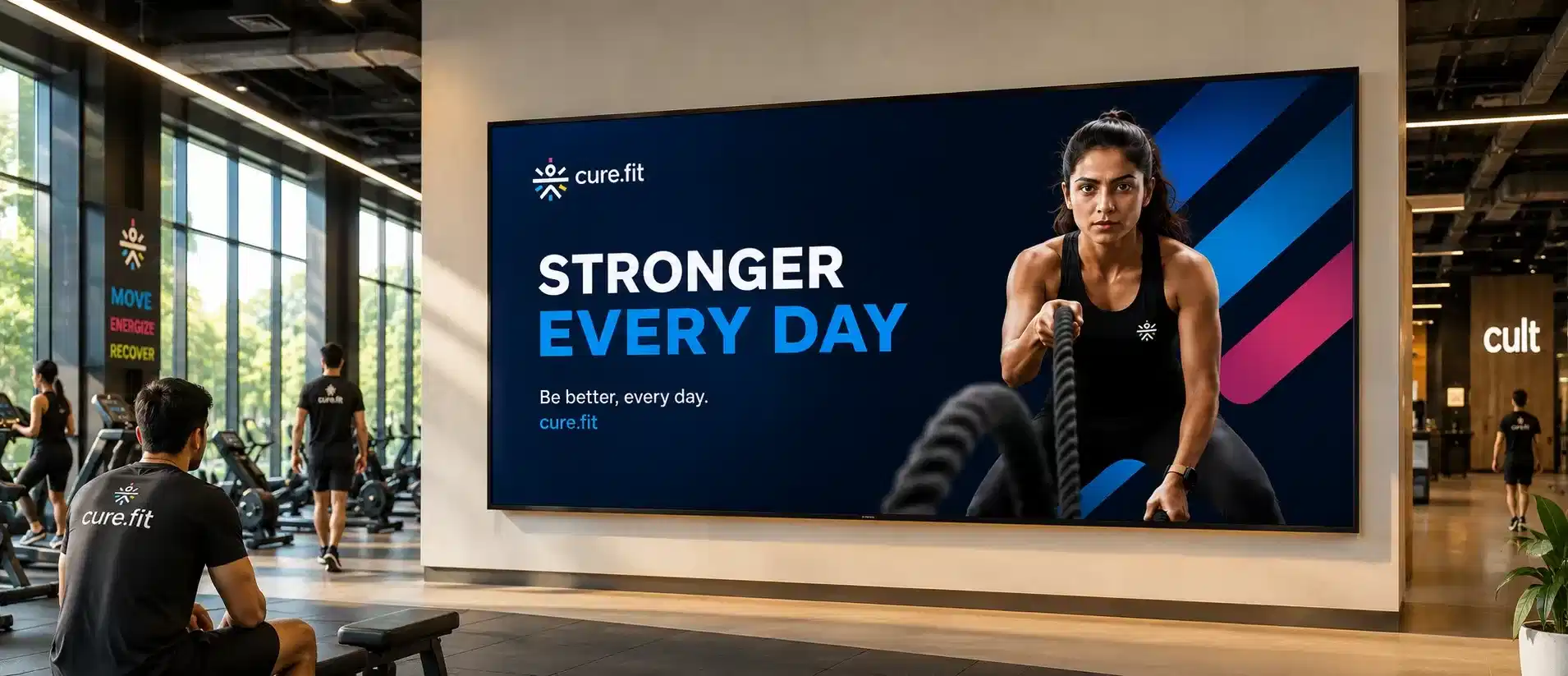
This gym digital signage case study covers Cure.Fit and Cult.Fit, the office and fitness-center arms of the same wellness brand, and how they use Pickcel's digital signage platform to run two distinct screen networks across India and Dubai. Cure.Fit needed to strengthen internal communication among office staff, while Cult.Fit needed to push class schedules, offers, and health information to gym members across a large, growing network of centers, all through a system simple enough for non-technical staff to run without IT support. Pickcel deployed a hardware-agnostic platform compatible with Windows, Unix, Android, and Chrome OS, built-in News and Weather apps, and on-site staff training. Cure.Fit's offices now display weather, news, meeting schedules, and birthday messages, while Cult.Fit's gyms display class schedules, trainer profiles, and membership offers to every visitor.
Client
Cure.Fit (corporate offices) / Cult.Fit (fitness centers)
Industry
Fitness & Wellness
Locations
230+ Cult.Fit workout centers across 15+ Indian cities
Countries
India and Dubai
Hardware
Windows, Unix, Android, Chrome OS (hardware-agnostic)
Platform
Pickcel cloud-based digital signage software
Two business units, one shared communication problem
Printed notices in the offices. Manual updates across 230+ gym locations. Neither team had IT to spare.
Cure.Fit's offices ran on email and printed notices
Before adopting a digital signage platform, Cure.Fit's office teams in India and Dubai relied on email and printed notices to share weather updates, meeting schedules, and internal announcements, the kind of day-to-day update an employee communication app is built to carry instead. The company's motto, “Be Better Everyday,” extended to how it wanted employees to feel connected and recognised at work, but static communication tools made that hard to sustain day to day.
Cult.Fit's growing network made manual updates inconsistent
On the fitness side, Cult.Fit ran a growing network of workout centers spread across more than fifteen Indian cities. Front-desk staff and trainers needed to keep members informed about class timings, membership offers, trainer changes, and health tips, often several times a week. Doing this manually at every location, with printed schedules and word of mouth, produced inconsistency between centers and left little room for last-minute changes. A cancelled class or new offer needed to reach every center the same day, not whenever a printed board got updated.
Both businesses needed something staff, not IT, could run
Both businesses shared one constraint: whatever replaced these manual processes had to be simple enough for gym trainers and office administrators, not IT teams, to operate on their own. Neither team had the bandwidth to manage a signage system that needed specialist setup for every content change.
“A cancelled class or new offer needed to reach every center the same day, not whenever a printed board got updated.”
One Hardware-Agnostic Platform for Offices and Gym Floors
Cure.Fit and Cult.Fit run both use cases from a single Pickcel account, connected to the Windows, Unix, Android, and Chrome OS devices already in place across offices and gym floors.
One Pickcel account for both offices and gym floors
Cure.Fit and Cult.Fit adopted Pickcel's digital signage software to run both use cases from a single account, without maintaining separate systems for the office and the gym floor. Because Pickcel is hardware-agnostic, both businesses connected the platform to the Windows, Unix, Android, and Chrome OS devices they already had, avoiding a forced hardware refresh in either environment.
Remote scheduling replaced screen-by-screen visits
Pickcel's remote, authenticated dashboard let administrators at both companies schedule and update content from anywhere, rather than visiting each screen in person. Two integrated apps handled much of the daily content: the News App kept Cure.Fit's offices current on company updates, and the Weather App gave both business units a live, always-relevant piece of content that needed no manual entry. Screen layouts were configured per location, so a corporate office display and a gym-floor display could carry different content zones from the same account, without needing two separate platforms.
On-site training put daily control with local staff
Pickcel's team also trained on-site staff at Cult.Fit's centers directly, so trainers and front-desk employees could manage their own screens without escalating to IT. Ongoing support after go-live meant neither business had to build in-house signage expertise to keep the system running. Administrators queue content once and let it play on a schedule, rather than manually swapping screens between a class-timetable view and a promotional one throughout the day.
From Manual Updates to One Dashboard for Both Business Units
230+ Cult.Fit centers on one dashboard
Neither business has needed to expand its internal IT footprint to keep the system running — the original requirement for both Cure.Fit and Cult.Fit.
Cure.Fit's offices now run a steady stream of internal content on screen: weather, company news, meeting schedules, and birthday and welcome messages that used to depend on someone remembering to send an email. Staff see relevant information without opening a separate app or inbox, one example of what corporate digital signage can do for everyday office communication.
Across Cult.Fit's workout centers in more than fifteen Indian cities, screens now carry class schedules, membership programs, trainer profiles, offers, and health and diet content, updated centrally instead of printed and replaced by hand at each location. Front-desk staff no longer need design or IT skills to keep information current, and members see the same standard of presentation whether they train at a flagship center or a smaller neighbourhood gym.
See How Others Use Pickcel
How My Salon Suite Scaled Digital Signage Across 200 Franchise Locations with Pickcel
See how My Salon Suite deployed Pickcel's digital signage across 200 franchise locations, scaling a Salesforce-synced pilot to 250+ screens company-wide.
Read case study →
How Decathlon Standardized In-Store Digital Signage Across Its Retail Network
See how Decathlon used Pickcel to keep promotions, product information, and in-store messaging consistent across a large multi-location sports retail network.
Read case study →
How HungerBox Simplified Order Queue Management at Corporate Cafeterias
See how HungerBox used Pickcel to manage order queues and live menu updates across corporate cafeteria screens at scale.
Read case study →Questions About Cure.Fit & Cult.Fit's Rollout
How does digital signage help gyms communicate class schedules and offers?+
Digital signage gives gyms one dashboard to push class schedules, membership offers, and trainer updates to every screen at once, rather than relying on staff to update boards at each site individually. Cult.Fit uses this to update its network of fitness centers the same day a schedule changes, without visiting each site.
Can one digital signage platform serve both office and gym-floor use cases?+
Yes, one Pickcel account can run entirely different content types for different environments, as Cure.Fit and Cult.Fit show. Cure.Fit's offices display internal news and meeting schedules, while Cult.Fit's gyms display class timings and offers, both managed from the same hardware-agnostic platform without separate systems.
How many Cult.Fit locations run on Pickcel's platform?+
Cult.Fit runs Pickcel's digital signage platform across 230+ workout centers in more than fifteen Indian cities. Screens at each location display class schedules, membership programs, trainer profiles, and offers, updated centrally rather than printed and replaced at each site.
Does Pickcel support hardware-agnostic deployment across Windows, Unix, Android, and Chrome OS?+
Yes, and for a buyer that means not having to standardize on one device brand or OS before rollout, the audit most IT teams run before approving new software. Cure.Fit and Cult.Fit kept their existing Windows, Unix, Android, and Chrome OS devices across both business units and never submitted a hardware purchase request to get started.
What kind of content do Cure.Fit employees see on office displays?+
Cure.Fit's office displays split into two content types: automated feeds from Pickcel's News App (company updates) and Weather App (local conditions), plus manually queued items like meeting schedules and birthday or welcome messages that administrators add through the same dashboard. The automated feeds update without any staff input; the manually queued items still take one dashboard entry, not a screen-by-screen change.
Is the platform simple enough for non-technical gym staff to manage?+
Yes, rather than handing over a manual and expecting gym staff to self-train, Pickcel ran onboarding in person, so trainers and front-desk employees could run their own screens without waiting on outside help. Setup and configuration stay with Pickcel; day-to-day content changes stay with whoever is on shift, with nothing routed through IT.
Does Pickcel support wellness brands operating in multiple countries?+
Yes, Cure.Fit and Cult.Fit run both business units, and both countries, India and Dubai, from the same Pickcel account. Administrators log in once regardless of which country's screens they're updating, so a cross-border wellness brand doesn't need a separate tool, contract, or login per region.