
Oct 22 2024

7 min read
February 04, 2026
4 min read


If you listen to how decisions actually get made behind closed doors, most B2B product adoptions come down to two questions:
Will this help us make more money?
Will this help us spend less to run the business?
Most enterprise systems pass this test cleanly. CRMs improve sales efficiency. ERPs optimize operations and cost. HR platforms streamline workforce management.
Those that don’t are often labeled “good to have,” regardless of their actual impact on day-to-day operations.
Digital signage usually ends up in this category—filed away as a visual layer that’s useful, but non-essential.
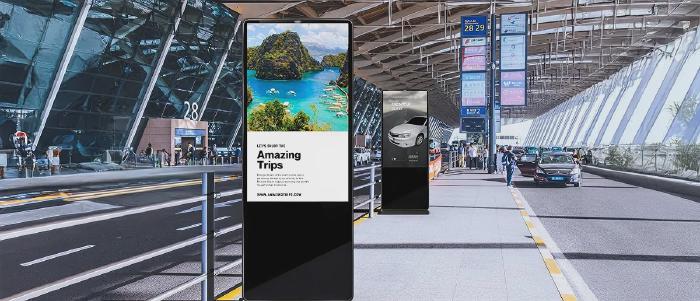
For decades, signage has sat on the sidelines of technology strategy. It has been treated as a display solution, a visual enhancement, and a “TV-on-the-wall” use case. Teams are more focused on display size, brightness, placement, and installation timelines.
By the time they turn to software decisions, the framing has already shifted toward deployment speed. The CMS is chosen to enable basic playback rather than ongoing decision support.
A fair objection often comes up here: Wasn’t signage always simple?
For a long time, it was.
Early signage ran on static loops with low expectations. Content changed infrequently. Software did very little. The screen itself was the product.
Over time, it became a way to distribute information across locations and teams, when it actually matters .
Signage is a system that bridges complex backend tools and the people who need to act on that information.
In other words, it becomes the last-mile communication layer: where information finally becomes visible, shared, and actionable in real operational spaces.
This isn’t about a few “special” industries. It shows up anywhere people rely on shared, time-sensitive information. Some environments just make the shift more obvious.
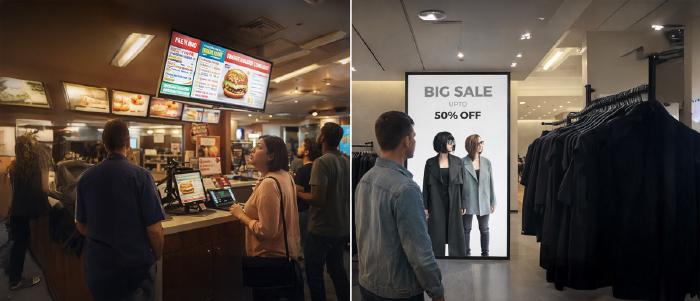
Menus change. Promotions rotate. Limited-time items come and go. The decision window is short, and what’s visible at that moment heavily influences what gets ordered.
In the case of Magnolia Bakery, signage wasn’t about adding screens for the sake of it. The problem was consistency and control. Menus and product visuals needed to be updated across multiple outlets without adding operational overhead or relying on manual changes at each location.
Signage solved that by making menu updates fast, centralized, and visually consistent.
Retail presents a different challenge. Here, decisions aren’t made at a single point. They’re shaped as customers move through the store environment—by what they notice first, what feels relevant, and which promotions stand out at the right moment.
At Decathlon, the challenge wasn’t whether signage could influence shoppers. The question was whether communication could scale across hundreds of stores without becoming chaotic. Promotions needed to roll out quickly, stay consistent, and still allow store teams some flexibility.
Signage made that possible by turning in-store messaging into a coordinated system rather than a series of manual tasks.
The same pattern shows up inside organizations. Internal communication often suffers from fragmentation—emails, chats, portals, and updates competing for attention across the workplace. Important messages get buried, and alignment becomes harder as organizations grow.
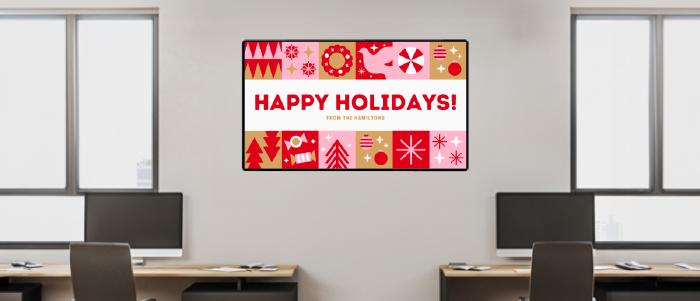
In the corporate communication setup at Mercedes-Benz Berlin, signage wasn’t introduced as a branding exercise. It was used to reliably surface internal updates, announcements, and communication across office spaces—within strict governance, security, and compliance requirements.
The common thread is simple: across environments, signage stops being “good to have” the moment it becomes responsible for keeping information current, reducing execution friction, and supporting decisions where timing and visibility matter.
Digital signage has always influenced outcomes—just in ways that don’t show up neatly in revenue attribution or cost dashboards. That’s why it keeps getting treated as an add-on rather than a system.
What needs to change is how signage decisions are made and the seriousness with which the CMS behind it is chosen.
One shift many teams working in fast-changing and distributed environments learned the hard way—especially post-COVID—is that communication is not a soft function. It is infrastructure.
The real question is no longer: “Do we need digital signage?” It’s: “Why is critical information still trapped inside systems, instead of reaching people when it actually matters?”

Oct 22 2024
7 min read
Feb 20 2026
6 min read

Feb 17 2026
6 min read
Feb 2 2026
9 min read
Take complete control of what you show on your digital signage & how you show it.
Start Free Trial Schedule My Demo