
Sep 19 2025

8 min read
September 15, 2025
8 min read


ALL
CORPORATE

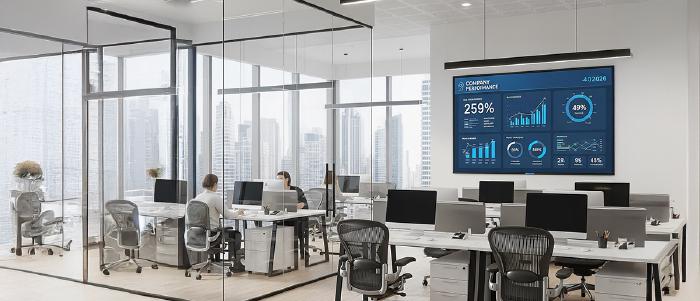
Every workday looks relatively the same. We walk in at around 9:00 am, settle at our desk, run through the day’s priorities, attend meetings, take notes, grab a coffee, and continue ticking items off the list until it’s time to leave. On paper, it looks productive. In reality, much of this time is spent in repetitive exchanges of information, updates in meetings, data buried in emails, or dashboards hidden in shared folders.
This has been the rhythm of USA corporate life for decades. But the question is, how much of it truly drives impact? Research suggests not a lot.
Studies show that long working hours with monotonous tasks do not lead to an increase in productivity.
What if communication didn’t feel this way? What if instead of sifting through cluttered emails or endless reports, teams could instantly see, understand, and act on information.
That’s where visual communication steps in, not just as a tool, but as a catalyst for clarity, engagement, and a healthier workplace culture.
Workplace culture is not built in mission statements. It is built every day through how employees communicate. The more transparent, engaging, and timely that communication is, the stronger the culture becomes.
But alignment is tough when employees are checking dozens of emails, chat apps, and portals every day. Most of it gets lost in the noise. Visual communication solves this by cutting through the clutter, placing information front and center in a format humans process 60,000x faster than text.

As design researchers point out, visual elements like color and shape make internal communication in USA offices not only clearer but also more engaging, leading to stronger employee connection and satisfaction.
Over the years, I too have invested in office tools- email suites, dashboards, messaging apps. But the irony is, my own team often felt less connected. The breakthrough happened when communication became visual with display screens and visual elements.
Digital signage in USA offices is no longer a ‘nice-to-have,’ it’s the backbone of visual communication. It’s immediate, democratic, and transparent. It turns information into culture.
When businesses place information on digital screens across lobbies, breakrooms, elevators, or conference areas, they eliminate silos and ensure that people are not just working but working with shared clarity.
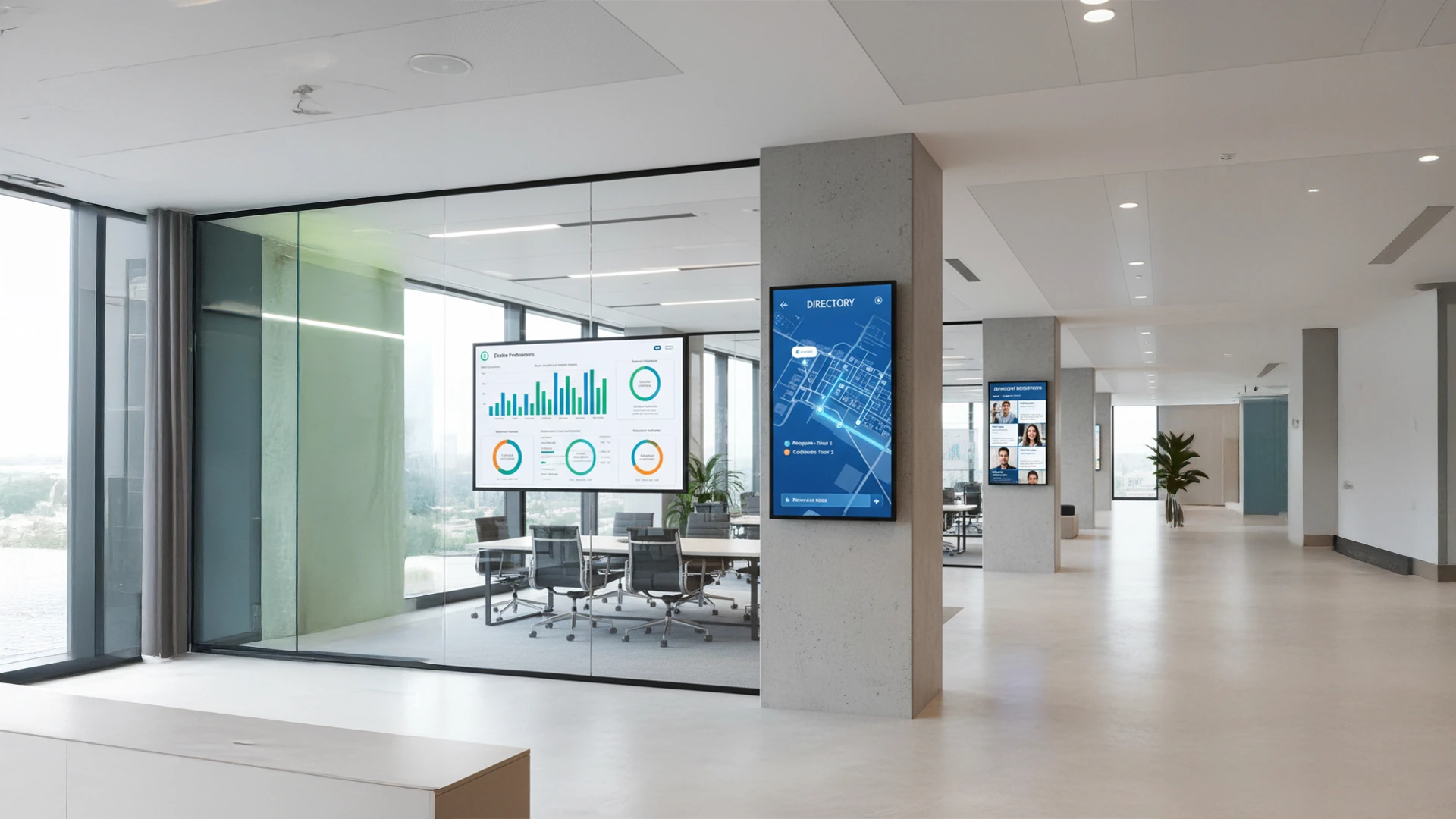
I’ve seen digital signage evolve from a nice-to-have lobby feature into a strategic employee communication in USA offices. Today, it serves multiple purposes that directly influence workplace culture:
Driving Transparency and Alignment
Alignment is one of the strongest drivers of workplace culture, but it’s also one of the hardest to measure. A recent Forbes article highlights this challenge.
When companies stream real-time goals and KPIs on visual displays, they are not just sharing numbers. They are making their purpose visible and operational. Employees see where the company stands, how their work connects, and where they can contribute. This level of transparency builds accountability, pride, and a stronger sense of belonging.
Making Meetings More Efficient
Meetings are infamous for running long and draining energy. Signage screens in conference rooms can make meetings more engaging by displaying real-time dashboards, summarized notes, charts and facilitating online meetings better. This reduces catch-up time and shifts discussions from “what’s happening” to “how do we improve”.
Enhancing Recognition and Motivation
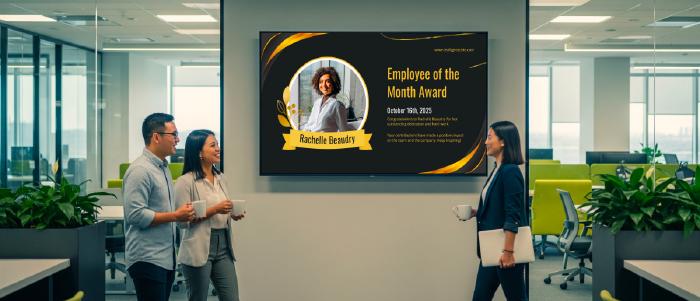
Recognition is one of the most powerful motivators. Celebrating achievements through leaderboards, employee spotlights, and milestone announcements on digital screens creates a culture where contributions are visible, not buried in private emails. Small acknowledgments, displayed publicly, build loyalty.
Simplifying Wayfinding and Navigation
In large corporate campuses across New York, Chicago, or Silicon Valley, navigating buildings can be frustrating. Signage displays work as wayfinding systems, guiding employees and visitors seamlessly to meeting rooms, departments, or events. Beyond saving time, it reduces stress which is an often-overlooked factor in workplace satisfaction.
Supporting Safety and Compliance
When it comes to health protocols, emergency procedures, or compliance reminders, digital displays are indispensable. Whether it’s a fire drill or an immediate security alert, large visible screens communicate faster and more effectively than emails or intranet pop-ups.

Culture is influenced not only by the presence of signage screens but also by what plays on those screens. In progressive workplaces, I’ve noticed content playlists that benefit different teams like management and operations, IT and security, marketing and sales teams.
This include:
Live performance dashboards – Display real-time updates, sales goals, and customer feedback to keep teams aligned and motivated.
Employee recognition highlights – Showcase achievements, birthdays, and milestones to boost morale and create a culture of appreciation.
Wellness and safety messages – Share health reminders, compliance protocols, or emergency alerts for a safer, more informed workplace.
Cafeteria menus and shuttle schedules – Reduce daily friction by providing easy access to food options and commute updates.
Upcoming training or cultural events – Promote lunch and learn sessions, workshops, or cultural activities that strengthen workplace community.
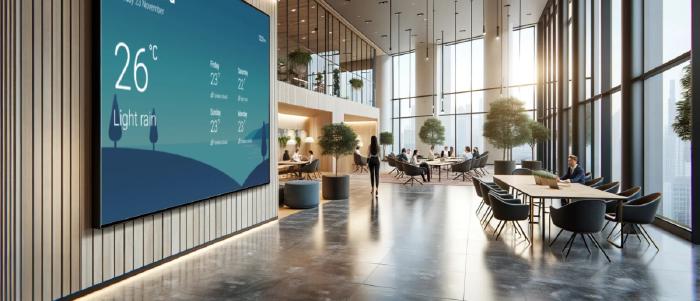
External updates like news & weather – Keep employees connected to the outside world, ensuring they stay informed beyond office walls.
This blend of operational, human, and contextual information makes signage not just a tool, but a daily companion. It keeps employees informed, engaged, and connected to the workplace beyond their desks.
Interestingly, office communication extends beyond the premises. Many corporations host annual meetings, client events, or conferences in hotels and convention centers.
Here, the crossover between hotel signage and office digital signage in USA corporations becomes evident.
Hotels leverage signage for:
Conference schedules
Digital wayfinding for event halls
Live updates on keynote sessions
Branding opportunities for corporate hosts
This seamless extension shows how visual communication ties the professional journey together whether an employee is at the desk, in the cafeteria, or at an off-site event.
While the benefits are clear, executives often raise an important question: how do we secure office communication in USA premises on digital display signage?
The answer lies in modern digital signage software in USA networks.
Today’s platforms offer:
On-site signage setup - On premise digital signage in USA corporates gives full control over their communication systems, ensuring sensitive data never leaves internal servers.
Centralized management - Manage and update content seamlessly across multiple offices, campuses, or even countries from a single dashboard.
Access controls - Role-based permissions ensure only authorized team members can create, edit, or publish content, reducing errors and risks.
Encryption & compliance - Advanced security protocols protect real-time dashboards, financial data, and corporate metrics in line with industry regulations.
The balance is simple. The stronger the digital signage security in USA offices, the more confidently organizations can use it for high-value communication.
The conversation about signage screens is not about technology, it’s about outcomes. The question every leader should ask is:
Are employees aligned with the company’s direction?
Do they feel recognized and motivated?
Is information reaching them in the most effective way possible?
Are we building a culture of transparency, safety, and shared progress?
Digital displays are not the only answer, but it is one of the most direct, visible, and scalable solutions to address these cultural gaps.
The workplace of tomorrow is not defined by open-plan offices or hybrid policies alone. It’s defined by how seamlessly information travels across people, spaces, and devices.
Digital screens are positioned to become the central operating system of modern workplace communication in USA. Integrated with AI-driven insights, data analytics, and even mobile extensions, it will ensure that every employee, whether in headquarters, a satellite office, or a hotel event. It stays connected to the organizational pulse.
The bottom line is simple: workplaces that invest in strong visual communication will not just inform, they will inspire.
And in a competitive environment where culture is as critical as strategy, that inspiration will be the differentiator.
Visual communication uses displays, graphics, and signage to share information instantly, making it easier for employees to absorb and act on updates.
By displaying real-time data, employee recognition messages, safety alerts, and events, signage ensures employees see key information without relying only on emails or meetings.
Strong workplace communication aligns employees with company goals, reduces silos, and builds a culture of transparency and motivation.
It’s the use of digital screens in US workplaces to display KPIs, announcements, recognition, and wayfinding, improving internal communication and employee experience.

Sep 19 2025
8 min read
Sep 16 2025
10 min read

Sep 8 2025
9 min read
Aug 21 2025
10 min read
Take complete control of what you show on your digital signage & how you show it.
Start Free Trial Schedule My Demo