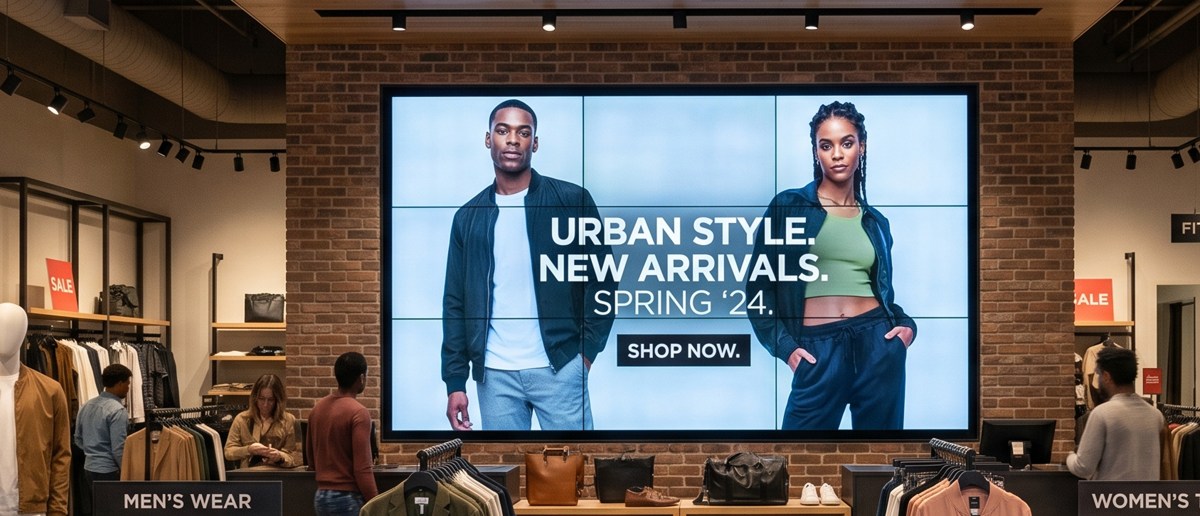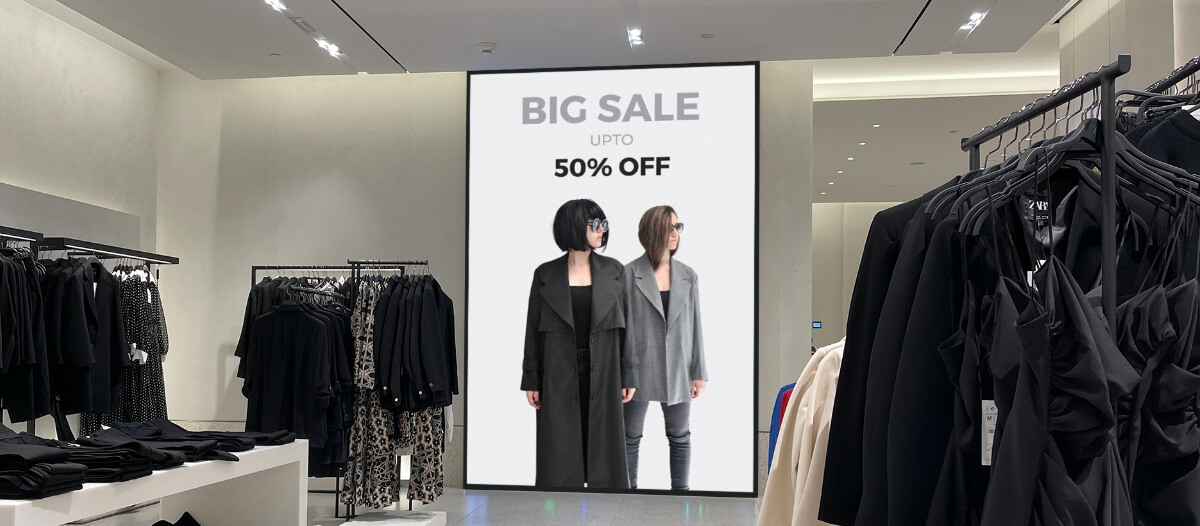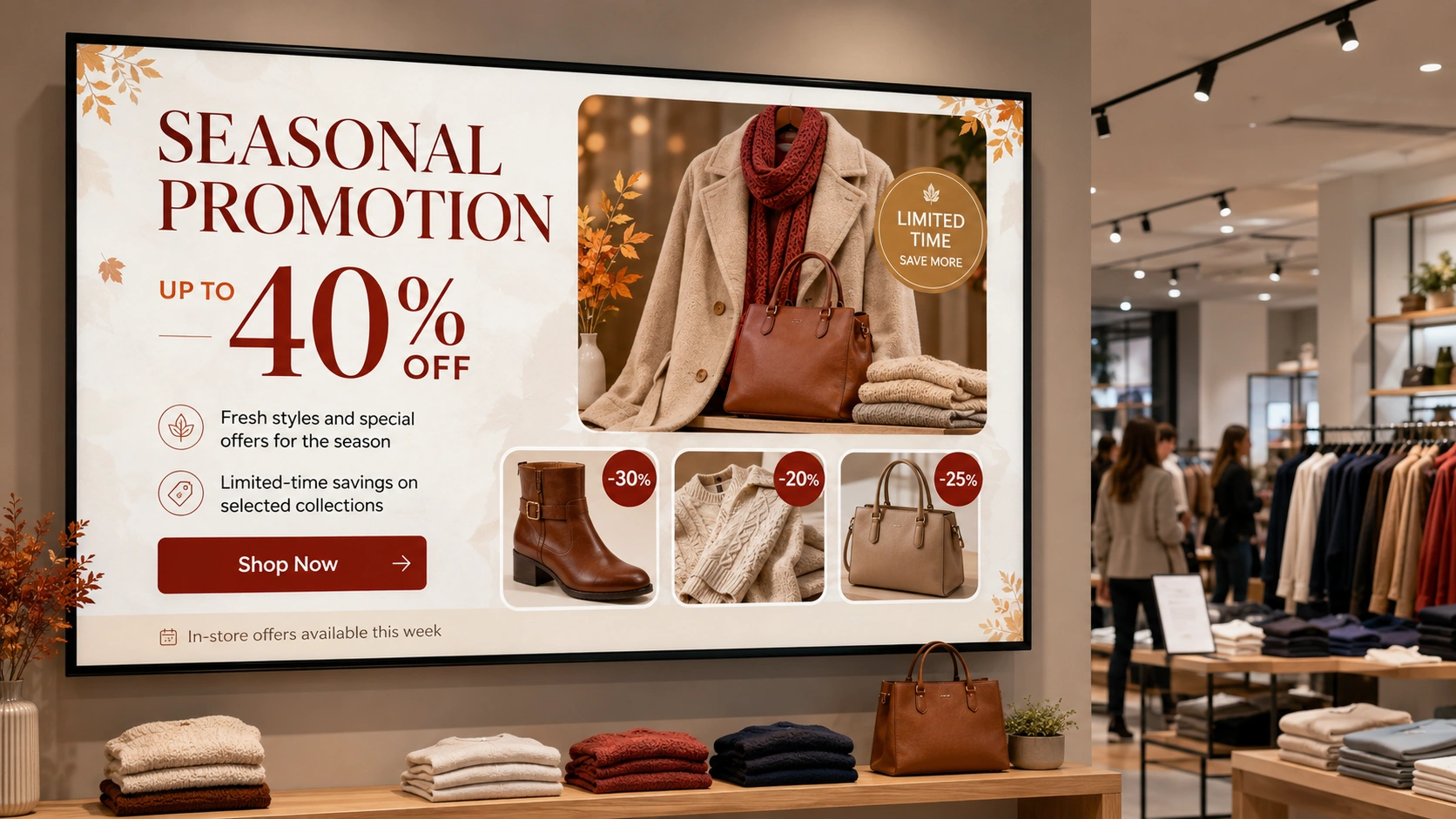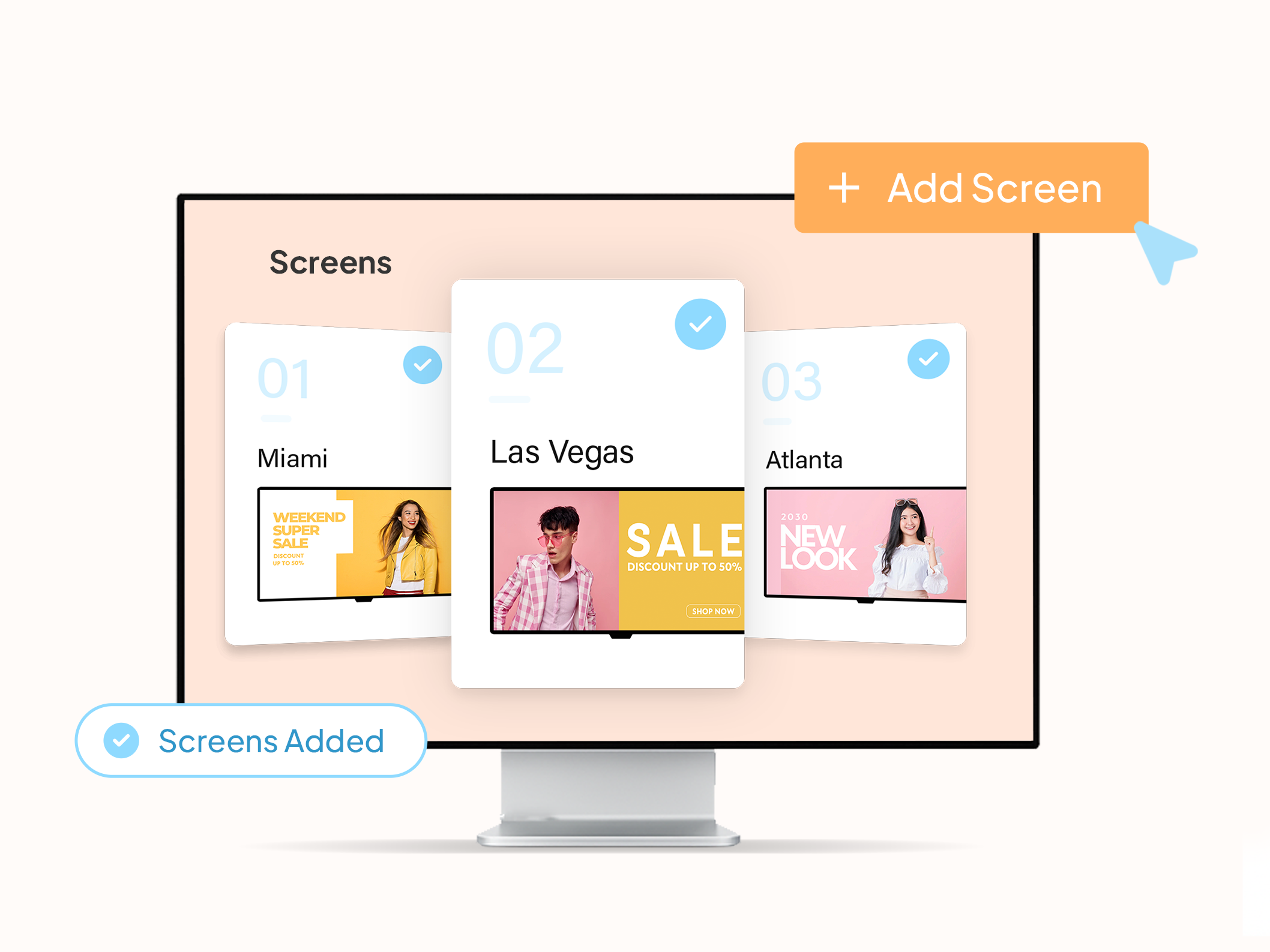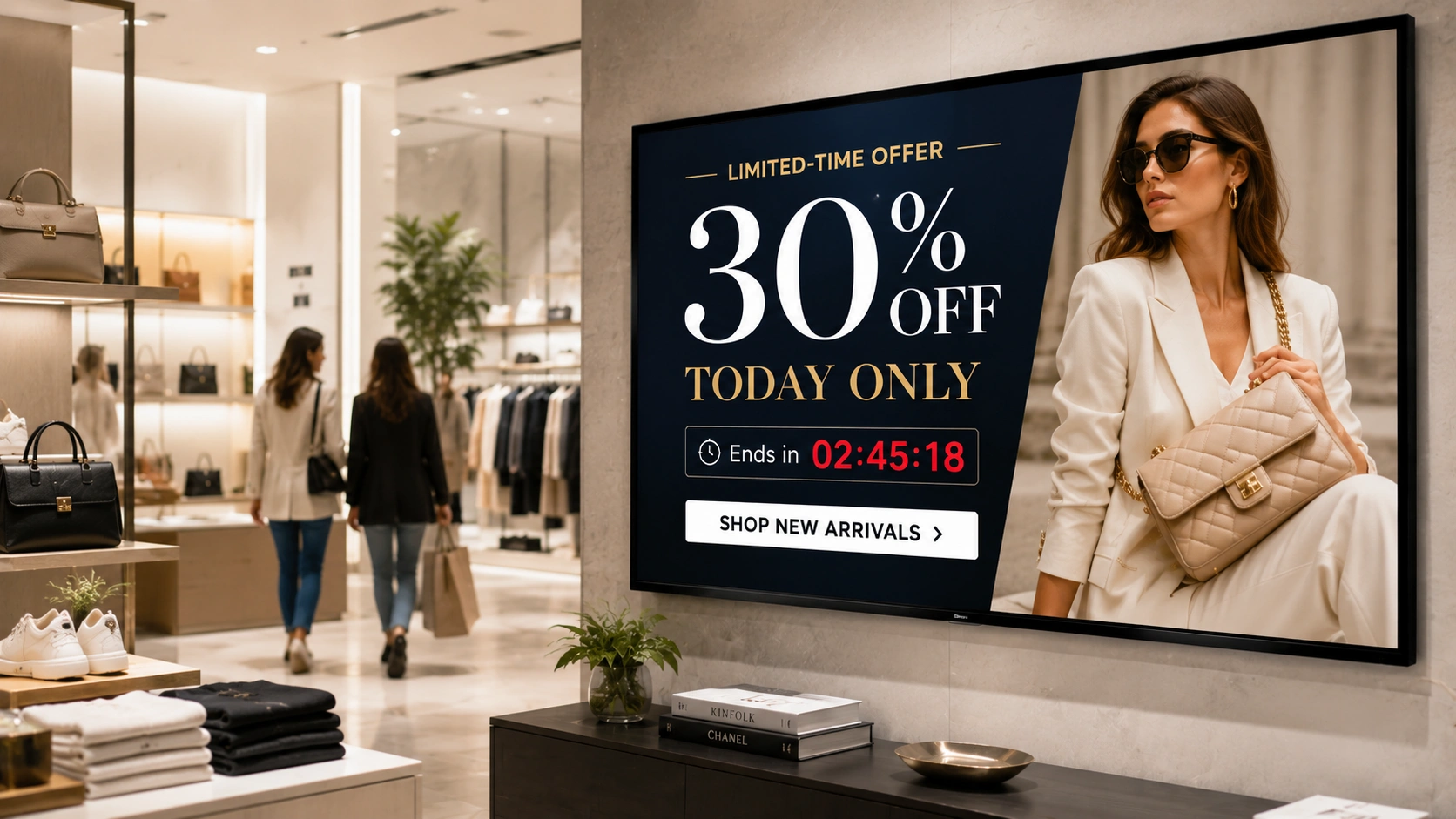
Five practical tactics to turn in-store screens into active engagement touchpoints — and how Pickcel helps retail teams run each one across every location.
See how digital signage engages retail customers →
- Dynamic retail displays consistently outperform static materials at capturing shopper attention.
- Each tactic addresses a measurable retail outcome: dwell time, conversion, or basket size.
- Content freshness matters more than screen count for sustained engagement.
What Is Retail Digital Signage Customer Engagement?
Retail digital signage customer engagement is the measurable influence that in-store digital screens have on shopper behaviour — from the moment a customer notices a display to how long they spend in a zone, whether they explore adjacent products, and what they decide to purchase. Unlike static printed materials, digital signage actively shapes the shopping journey through scheduled content, real-time promotions, and updatable messaging that can be changed remotely without altering physical store layouts. The term covers both passive scheduled displays and interactive touchscreen installations across all in-store contexts.
The In-Store Engagement Gap
Foot traffic is recovering in retail. Conversion rates are not.
Shoppers walk into stores, spend time browsing, and leave without buying. The reasons vary: they could not find what they wanted, a promotion did not register, or the in-store experience did not hold their attention long enough to influence a decision.
The gap between online and in-store engagement is real. Online channels deliver dynamic recommendations, contextual pricing, and social proof at every scroll. Physical retail, in too many stores, offers shelf labels and printed posters.
Digital signage closes that gap. It gives retailers the same dynamic, content-driven experience that online channels use to influence behaviour — applied to the physical environment where the purchase actually happens. For a broader look at how screens translate to revenue, see how retail digital signage customer engagement drives measurable business results across store formats.
For a wider view of how digital signage drives customer engagement in retail, alongside other proven levers like staffing, layout, and checkout flow, see our companion guide to improving the retail customer experience overall.
The five tactics below cover specific ways digital signage changes retail customer engagement, with practical context for how each one works and what to expect. For how to measure the commercial return from these tactics, see our guide on retail digital signage ROI .
5 Ways Digital Signage Improves Retail Customer Engagement
1. Dynamic Product Storytelling
Digital screens give retailers the ability to move beyond price cards and create a visual narrative around products that static materials cannot support.
Instead of a single shelf tag, a display can loop lifestyle video, close-up product detail, and a usage context within the same 30-second sequence. Shoppers who stop to watch a product story spend more time in that zone, which increases the likelihood they engage with nearby merchandise. Motion and video formats hold shopper attention more effectively than fixed images or text, particularly in environments where visual competition from multiple product lines is high.
Pickcel’s digital signage software lets retail teams load brand-produced video, imagery, and lookbook slides into a centralised content library and schedule them against specific display zones or dayparts. A fashion retailer can show evening outfit ideas from mid-afternoon. A home goods retailer can align content with the season currently featured on the floor. Content can be updated from head office without sending instructions to individual stores or involving in-store staff.
The practical outcome: visual product context gives shoppers a reason to pause and explore that printed signage cannot replicate — and it does so without adding labour at the store level.
2. Real-Time Promotions and Limited-Time Offers
Urgency changes buying behaviour. A static “Sale” sign is visual background noise after the first visit. A countdown timer on a screen next to the product registers as an event.
Digital signage allows retailers to run time-bounded promotions that printed materials cannot: flash deals active only during off-peak hours, price reductions on overstocked lines, and low-stock notices on specific SKUs. Because Pickcel’s scheduling tool lets teams set promotion windows by time and store location, a head office marketing team can push a targeted offer to 40 stores simultaneously and have it disappear automatically when the window closes.
This matters for retail operations managers who have historically needed store staff to swap out point-of-sale materials for every campaign. Remote content management removes that coordination cost entirely. The promotion runs, the window closes, and the next content slot loads — with no per-store action required.
For marketing managers running campaigns across multiple channels, digital signage fills the in-store leg of a campaign without creating a logistics problem for store teams.
3. Queue and Wait-Time Management
The checkout queue is one of the highest-risk moments in the customer journey. Shoppers who feel the wait is too long leave with a negative impression of the store — regardless of how the rest of the visit went.
The reason is well established in service operations research: unoccupied time feels significantly longer than occupied time (Maister, “The Psychology of Waiting Lines,” 1984). A shopper standing still with nothing to look at experiences every second of that wait acutely. A shopper engaged with a screen does not.
Research published in the Journal of Retailing and Consumer Services found that digital signage positively influences shoppers’ emotional experiences in retail waiting areas by occupying their attention during idle time and reducing the subjective discomfort of the queue. The study’s finding — that digital screens improve the emotional quality of the wait — is the mechanism behind reduced perceived wait time, distinct from any reduction in actual wait time.
In practice, a queue screen showing engaging content — a product feature, an upcoming event, a relevant editorial piece — changes the subjective experience of waiting. Pickcel supports queue-zone playlist management, which means checkout screens can be scheduled independently from main floor displays, allowing a content strategy tailored specifically to the waiting state.
Queue screens are also a productive upsell placement. A shopper who has already committed to a purchase is receptive to impulse additions, and a well-placed screen in that moment is a targeted commercial channel with no additional labour cost.
See what a managed retail screen network looks like
Book a personalised walkthrough of how Pickcel helps retail teams schedule zone-specific content, run time-bounded promotions, and manage queue screens from one dashboard.
4. Wayfinding and Store Navigation
Large-format retail, department stores, and multi-floor locations lose sales when shoppers cannot find what they are looking for. Navigation friction shortens visits and reduces the chance of discovery-based purchasing — the category of sale that static layouts rely on but rarely engineer.
Digital wayfinding screens address this in two directions simultaneously. First, they reduce navigation friction, directing customers to departments, service counters, and sale zones without requiring store associate involvement. Second, they create deliberate traffic pathways through the store. A display reading “New Spring arrivals this way” is both a directional aid and a traffic driver to a specific department.
Pickcel’s zone-mapping capability lets retail teams assign content to specific screens and update wayfinding messaging without physical changes to store layouts. During high-traffic periods, traffic flows can be adjusted in real time — useful during product launches, peak trading days, or in-store events where normal traffic patterns change.
There is a secondary effect worth noting: shoppers who find what they are looking for efficiently report higher satisfaction with the store visit. Navigation ease is not just a convenience — it directly affects how customers feel about returning.
5. Social Proof Displays
Shoppers look for reassurance before committing to a purchase, particularly on higher-value items. Customer reviews, user-generated content, and peer endorsements delivered in-store serve as the same trust signals that online product pages depend on — at the exact moment a physical purchase decision is being made.
A display showing verified review scores for a featured product, or a curated feed of real customers using an item, delivers peer validation that brand-produced imagery cannot match. It changes the psychological framing of the buying decision from “am I trusting this brand?” to “am I agreeing with people like me?”
Pickcel integrates with social platforms and supports pulling live user-generated content feeds onto retail screens, filterable by hashtag, account, or review score. The platform is trusted by 9,000+ businesses across 70+ countries, with over 150,000 screens under active management, and is certified SOC 2 Type II and ISO 27001. Retailers control what appears, so the display reflects curated peer content rather than unfiltered social media. UGC can be scheduled alongside brand content and updated remotely without in-store coordination.
The result is a trust signal that exists at the point of decision, not just online.
How to Keep Retail Digital Signage Content Engaging
Running digital signage with stale content defeats its purpose. A screen that has shown the same loop for three months becomes part of the store’s visual furniture. Shoppers stop noticing it, and the commercial value of the screen drops to near zero.
Four practices maintain engagement over time:
Content rotation schedules. Plan a creative calendar at least four weeks ahead. Rotate the primary content every two to three weeks. Pickcel’s scheduling tool lets teams queue changes in advance, so rotation happens automatically without per-store coordination.
Dayparting. Shoppers at 9 a.m. and at 6 p.m. are different people in different purchase states. A morning content plan oriented around browsing and inspiration performs differently from an afternoon plan built around commute-stop or end-of-day purchases. Match content to the time windows when your highest-value customer segments visit most often.
Campaign alignment. Screens should refresh on the same cycle as in-store merchandising. If the floor layout changes for a new campaign, the screen content should change with it. Pickcel’s bulk scheduling allows campaign assets to be uploaded once and distributed across all locations simultaneously, keeping screens and merchandise in sync. For multi-location networks where brand consistency matters, see our guide on franchise digital signage brand consistency .
Headline testing. Run two versions of a promotional message across different store zones for a defined period, then review dwell time or conversion data to see which version performs better. Moving content decisions from intuition to evidence is the difference between a managed screen network and an unmanaged one.
The most common objection to keeping digital signage content current: “We do not have the resources to refresh screens regularly.” Pickcel addresses this directly. Content updates are remote, bulk-schedulable, and template-driven. Store staff do not need to be involved in the content cycle. A small head office team can manage a 100-store network from a single digital signage software dashboard with the same tools used to manage a single location.
Frequently Asked Questions
How does digital signage improve customer engagement in retail?
What type of content works best for retail digital signage customer engagement?
Can Pickcel display UGC and social media content on retail screens?
How often should retailers update their digital signage content?
What is the difference between interactive and passive digital signage for retail engagement?
Conclusion
Retail digital signage customer engagement is not a hardware question. It is a content discipline question. The five tactics above — product storytelling, time-bounded promotions, queue engagement, wayfinding, and social proof — each address a specific moment in the shopper journey where static materials underperform.
The retailers who see the strongest results pair these tactics with a content calendar that keeps screens fresh and a measurement framework that ties campaigns to outcomes. Our companion guide on retail digital signage ROI covers how to quantify that return. For a related checkout-specific angle covering the exact screen placements, timing, and offer types that turn a committed shopper into a larger basket, see our breakdown of five digital signage upsell tactics for retail.
See what a managed retail screen network looks like
If you want to see how Pickcel works for retail teams, the fastest way is a personalised walkthrough with one of our team — bring your store layout and we'll show you the screens in action.