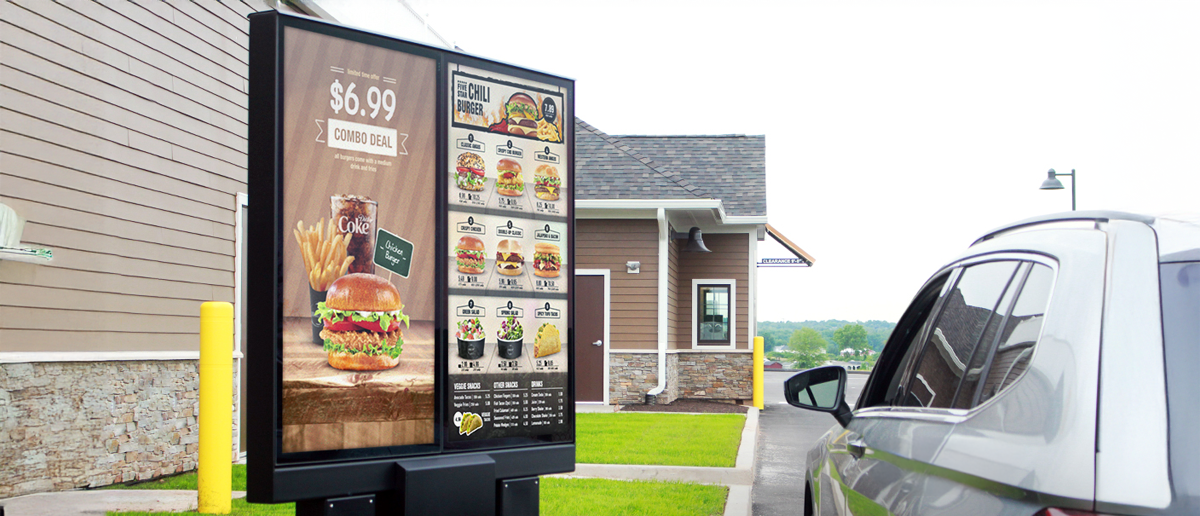
Everything you need to know about outdoor digital menu boards — hardware specs, brightness requirements, cost ranges, and how to manage them with Pickcel’s cloud CMS.
See Pickcel’s Digital Menu Board Solution →
- Outdoor digital menu boards require a minimum 2,500 nits brightness and IP65 weatherproofing for reliable exterior performance.
- Drive-through sales represent 70–80% of QSR chain revenue, making outdoor displays a critical investment for restaurant operators (QSR Magazine, 2023).
- Hardware costs range from $1,500 for entry-level outdoor screens to $40,000+ for full drive-through enclosure systems.
- Pickcel's cloud CMS manages indoor and outdoor menu boards from one account — price updates push to all screens in under 30 seconds.
- The outdoor digital signage market is growing from $6.9B (2023) to $14.2B (2030), driven by QSR drive-through modernization (Grand View Research, 2023).
Outdoor menu boards have been transformed by digital technology. Where static lightbox signs once required manual frame changes and printed inserts, modern outdoor digital menu boards update in seconds from any device. For QSR operators, franchise chains, and restaurant groups, the business case is straightforward: drive-through revenue is the single largest revenue channel, and what customers see on the outdoor display directly influences what they order. This guide covers what outdoor digital menu boards are, what hardware specifications matter, where they are used, what they cost, and how to set them up.
What are outdoor digital menu boards?
Outdoor digital menu boards are high-brightness electronic display systems installed in exterior locations to present menu content, pricing, and promotional offers to customers before they place an order.
Unlike indoor menu boards, outdoor displays face direct sunlight, rain, temperature extremes, dust, and vandalism risk. They are purpose-built for these conditions with ruggedized enclosures, anti-reflective glass, temperature management systems, and brightness levels far above what standard commercial displays can produce.
Outdoor digital menu boards appear in several configurations:
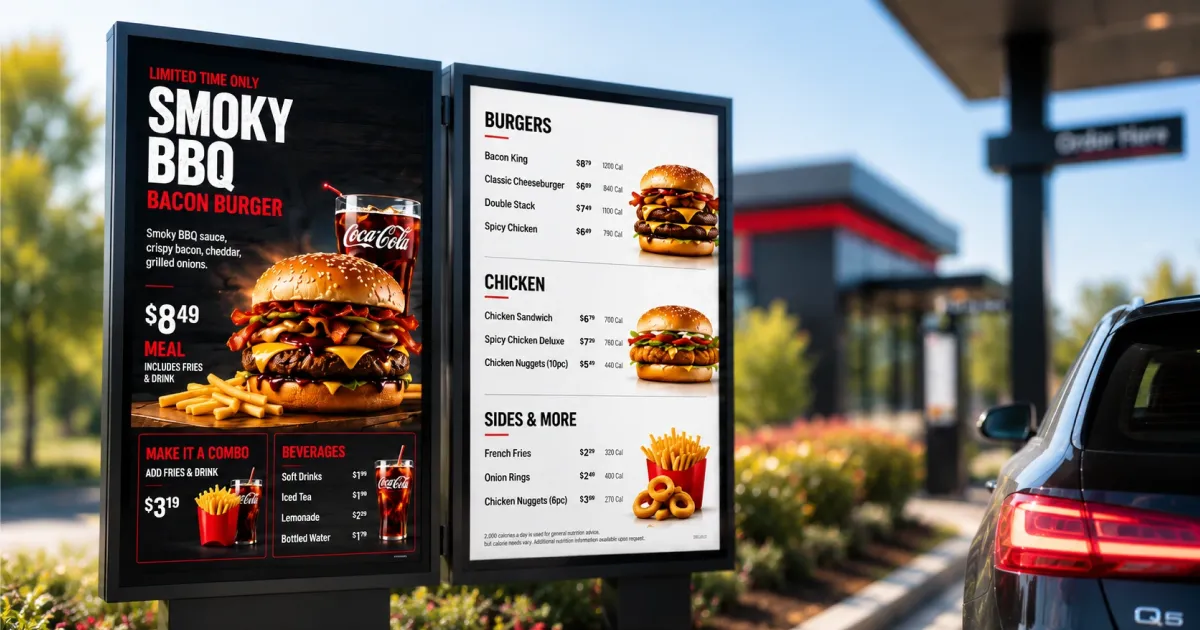
Drive-through order point displays: Typically 46–75 inch screens mounted on pedestals at the ordering station, showing the full menu and current promotions
Drive-through preview boards: Pre-sell displays positioned before the order point, guiding customers toward high-margin items
Exterior building-mounted displays: Menu boards visible from the street or parking area, functioning as both menu and marketing signage
Outdoor patio and terrace displays: Weather-rated screens at alfresco dining areas
MARKET SIZE
The global outdoor digital signage market was valued at $6.9 billion in 2023 and is projected to reach $14.2 billion by 2030, driven in large part by QSR chain investment in drive-through modernization (Grand View Research, 2023).
What features should an outdoor digital menu board have?
An outdoor digital menu board must meet six technical requirements to perform reliably in an exterior environment.
1. Brightness: minimum 2,500 nits
Standard commercial displays produce 300–500 nits. In direct sunlight, anything under 2,500 nits washes out completely. Drive-through installations in sunny climates often specify 3,500 nits or higher.
2. IP65 weatherproofing or higher
IP65 means the display is dust-tight and protected against water jets from any direction. Coastal or high-precipitation locations may require IP67. Always verify the IP rating applies to the full installed unit, not just the display panel.
3. Operating temperature range: -20°C to 60°C
Internal heating prevents condensation in cold climates. Cooling systems prevent thermal shutdown in hot environments. Verify the operating range matches your local climate extremes.
4. Anti-reflective or low-glare glass
Direct sun glare on uncoated glass makes content unreadable regardless of brightness. Anti-reflective coatings or circular polarization filters reduce surface glare while maintaining image clarity.
5. Vandal-resistant enclosure
Tempered glass (minimum 4mm) and reinforced steel or aluminum enclosures protect against accidental and intentional damage. High-vandalism locations may specify laminated security glass.
6. Remote content management compatibility
Manual content management at the screen is impractical across multiple locations. Any outdoor menu board worth the investment should connect to a cloud CMS. Pickcel's digital signage software lets operators update outdoor boards across all locations simultaneously from a single dashboard.
Where are outdoor digital menu boards used?
Outdoor digital menu boards appear across four primary restaurant and food service contexts:
70–80%
Drive-through QSR
Drive-through sales account for 70–80% of revenue at major QSR chains (QSR Magazine, 2023). Digital boards have been shown to increase average order value by 3–5% through upsell prompts and real-time LTO promotion (National Restaurant Association, 2022). See Pickcel's drive-through digital menu board solution.
Fast casual and coffee chains
Drive-through and walk-up formats at fast casual restaurants and coffee chains use outdoor boards to display seasonal menus, limited-time offers, and current pricing without manual sign changes between dayparts.
Outdoor food markets
Fixed stall operators in outdoor food markets use weather-rated displays to show daily menus, specials, and pricing that can be updated quickly when items sell out — without printed board replacements.
Fuel station forecourts
Forecourt display boards show current fuel prices, in-store food promotions, and car wash offers. These operate 24/7 in all weather conditions and require the highest durability ratings available.
How much do outdoor digital menu boards cost?
Outdoor digital menu boards represent a higher investment than indoor displays because of the specialized hardware required. Here are current market price ranges:
| Display Type | Typical Size | Approx. Cost Per Unit |
|---|---|---|
| Entry-level outdoor (2,500 nits, IP65) | 43–55 inch | $1,500–$3,000 |
| Mid-range outdoor (3,500 nits, IP65) | 55–65 inch | $3,000–$6,000 |
| High-end outdoor (5,000 nits, IP66, temp-managed) | 65–75 inch | $6,000–$15,000 |
| Drive-through enclosure system (dual board, full station) | Full station | $15,000–$40,000 |
Additional costs to budget:
- Installation and mounting: $500–$2,000 per screen
- Content management software: $15–$40 per screen per month (Pickcel)
- Connectivity: 4G/LTE SIM or Wi-Fi bridge if wired network is unavailable
- Maintenance contract: 10–15% of hardware cost annually
For a full cost breakdown including indoor boards and total cost of ownership, see Pickcel’s digital menu board cost guide .
How to set up outdoor digital menu boards with Pickcel
Setting up outdoor digital menu boards with Pickcel involves three phases:
Pickcel is trusted by 9,000+ businesses across 150,000+ screens in 70+ countries, including QSR operators managing multi-location digital menu board networks. Pickcel’s digital signage software manages both indoor and outdoor screens from one dashboard — the right platform for multi-format restaurant operations.
Restaurants at an earlier stage can explore free digital menu board software options before committing to a multi-screen outdoor deployment.
Managing indoor and outdoor menu boards across multiple locations?
Pickcel lets you update every screen from one dashboard — instantly. No USB drives. No manual visits to each location.
Indoor vs. outdoor digital menu boards — key differences
Understanding where indoor and outdoor boards differ helps operators make the right hardware choices. The CMS software works identically for both.
| Feature | Outdoor Board | Indoor Board |
|---|---|---|
| Brightness | 2,500–5,000+ nits | 300–700 nits |
| Weatherproofing | IP65 or higher required | Not required |
| Operating temperature | -20°C to 60°C | 0°C to 40°C |
| Anti-reflective glass | Required | Not required |
| Average hardware cost | $1,500–$15,000+ | $300–$3,000 |
| CMS software | Pickcel ✓ | Pickcel ✓ |
For the companion guide to indoor deployments, see our indoor digital menu boards guide .
Frequently Asked Questions
How bright should an outdoor digital menu board be?
Are outdoor digital menu boards weatherproof?
How much does an outdoor digital menu board cost?
Can Pickcel software run on outdoor displays?
What is the difference between a drive-through preview board and an order point menu board?
Ready to upgrade your drive-through menu boards?
Pickcel manages indoor and outdoor menu boards from one dashboard. 9,000+ businesses. 150,000+ screens. 70+ countries.