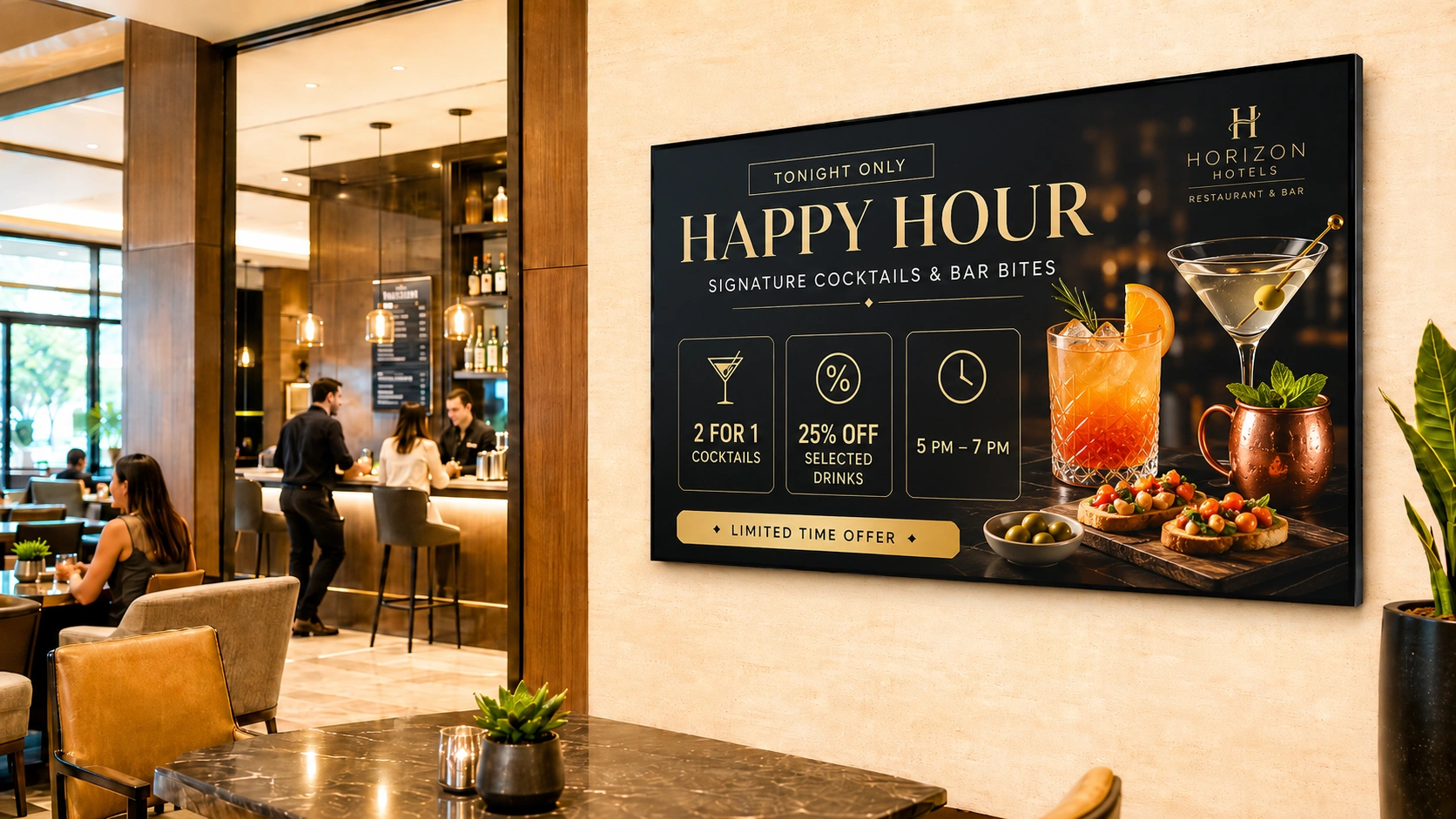
- Digital signage replaces nightly menu reprints across hotel F&B outlets.
- One CMS schedules content by outlet, meal period, and event.
- Premium visual templates suit fine-dining, not just QSR-style boards.
Explore Pickcel for Hospitality →
What is digital signage for hotel restaurants?
Digital signage for hotel restaurants is a cloud-managed display system that shows menus, pricing, and promotional content on screens across a hotel’s dining outlets, including restaurants, bars, lounges, and event spaces. A hotel F&B manager updates content once in a central dashboard, and the change pushes to every connected screen in real time. This differs from a single static menu board: it covers multiple outlets, multiple meal periods, and multiple content types from one system.
The problem with printed menus in hotel dining
A hotel’s food and beverage program changes more often than most other parts of the property. Breakfast service ends and lunch begins. The happy hour price card swaps out at 5 p.m. A private event books the ballroom for a six-course tasting menu that will run for one night only. Each of these moments traditionally means a reprint, a new chalkboard, or a staff member walking between outlets with a stack of paper inserts.
The cost is not only the printing. It is the staff time spent updating boards by hand at every outlet, the inconsistency between locations when one gets missed, and the lag between when a menu changes in the kitchen and when it reflects on the floor. For a hotel group running 5 to 50 properties, this multiplies across every dining outlet at every location.
Where hotels use digital signage across F&B outlets
Hotel F&B spans more outlet types than a standalone restaurant, and each one has a different signage use case. Hotels managing F&B at this scale often look to a dedicated hospitality digital signage strategy to coordinate outlets under one platform.
- All-day dining restaurant. The primary outlet, usually running breakfast, lunch, and dinner with separate menus for each period. Screens switch automatically by time of day. This outlet functions much like a standalone restaurant, and many of the same dedicated restaurant digital signage deployments patterns apply here.
- Hotel bar and lounge. Cocktail menus, wine lists, and happy hour pricing change frequently and need to look premium, not promotional.
- Rooftop or poolside outlet. Seasonal and weather-dependent menus, often paired with daytime drink specials and evening dinner service.
- Event spaces and banqueting. Private dining and conference catering need outlet-specific, time-boxed content that does not appear anywhere else on the property.
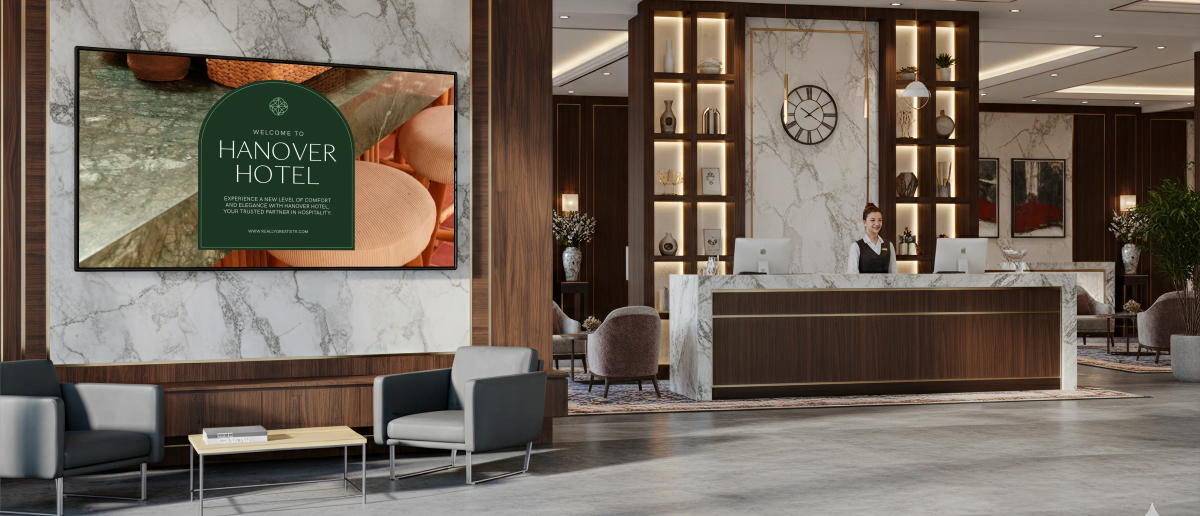
- Lobby dining promotions. A screen near the lobby or concierge desk that cross-promotes the hotel’s other F&B outlets to guests who have not yet decided where to eat.
Key use cases for hotel F&B digital signage
Daily menu boards by meal period
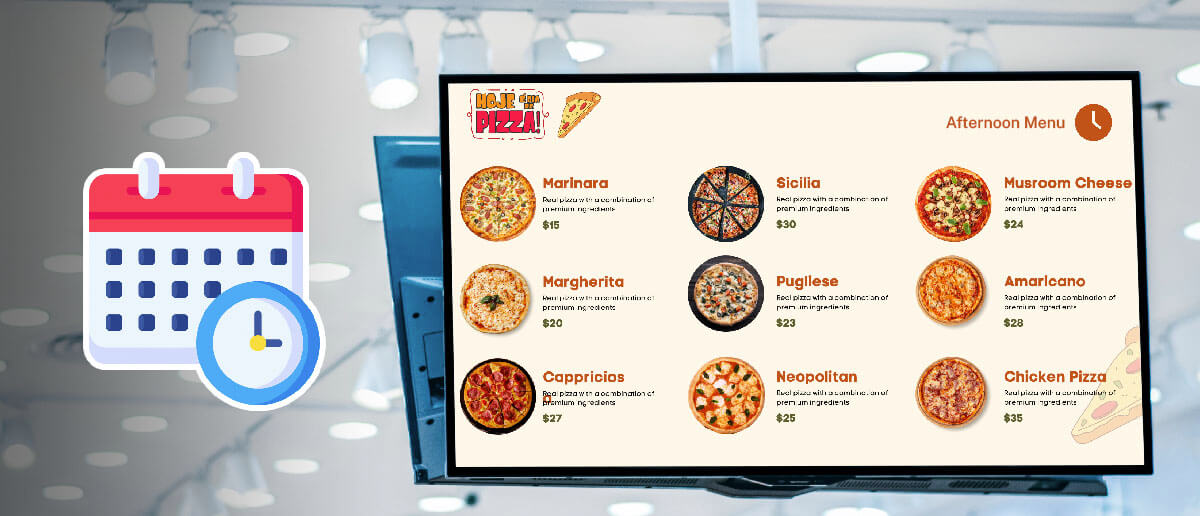
Breakfast, lunch, and dinner menus can be scheduled to switch automatically at set times, so the floor staff never manually swaps a board mid-shift. A property running a buffet breakfast and an a la carte dinner can run both from the same screen on a fixed daily schedule using Pickcel’s digital menu board . For the scheduling mechanics behind meal-period switching, see our guide on restaurant menu dayparts .
Happy hour and promotional pricing
Bar pricing that changes for a 2-hour happy hour window can be set to activate and revert automatically. This removes the chance of a bartender forgetting to switch the board back to standard pricing after the window closes.
Cocktail menus and wine lists
A wine list or cocktail menu on screen can be redesigned seasonally without reprinting laminated cards, and can rotate featured pours to support a specific supplier promotion for a set period.
Event night and private dining promotion
A six-course tasting menu, a holiday brunch, or a private event running for one night only can be scheduled to appear exactly when needed and disappear afterward, without leaving outdated signage in the space the next day.
Upsell prompts
Wine pairing suggestions next to an entree, or a dessert recommendation displayed near the end of dinner service, give the floor team a passive upsell tool that does not require a verbal pitch at every table. For more tactics on this angle, read our tips for restaurant digital signage and point-of-purchase marketing with digital signage. Restaurants that layer these prompts across a full service period, not just at the table, tend to see the biggest lift. Our guide to restaurant upsell digital signage strategies covers the specific screen placements and timing that drive that result across breakfast, lunch, and dinner service.
How to manage multiple hotel outlets from one CMS
A hotel group with several dining outlets across one or more properties needs outlet-level control without outlet-level effort. Pickcel’s screen and zone management lets an F&B manager assign specific screens to specific outlets, so the rooftop bar’s happy hour content never accidentally appears in the formal dining room.
Content can be scheduled per meal period across every outlet at once, so a corporate-wide breakfast menu update applies to every property simultaneously instead of one at a time. If a menu item runs out or a price needs an emergency correction, the change can be pushed to every affected screen from a single dashboard rather than relaying the update through individual outlet managers.
This outlet-by-outlet structure also supports brand consistency. A hotel group can lock visual templates centrally while still letting each property’s F&B team fill in local menu data, so every outlet looks on-brand without a designer touching every update.
Does this work for premium hotel dining, not just QSR-style menu boards?
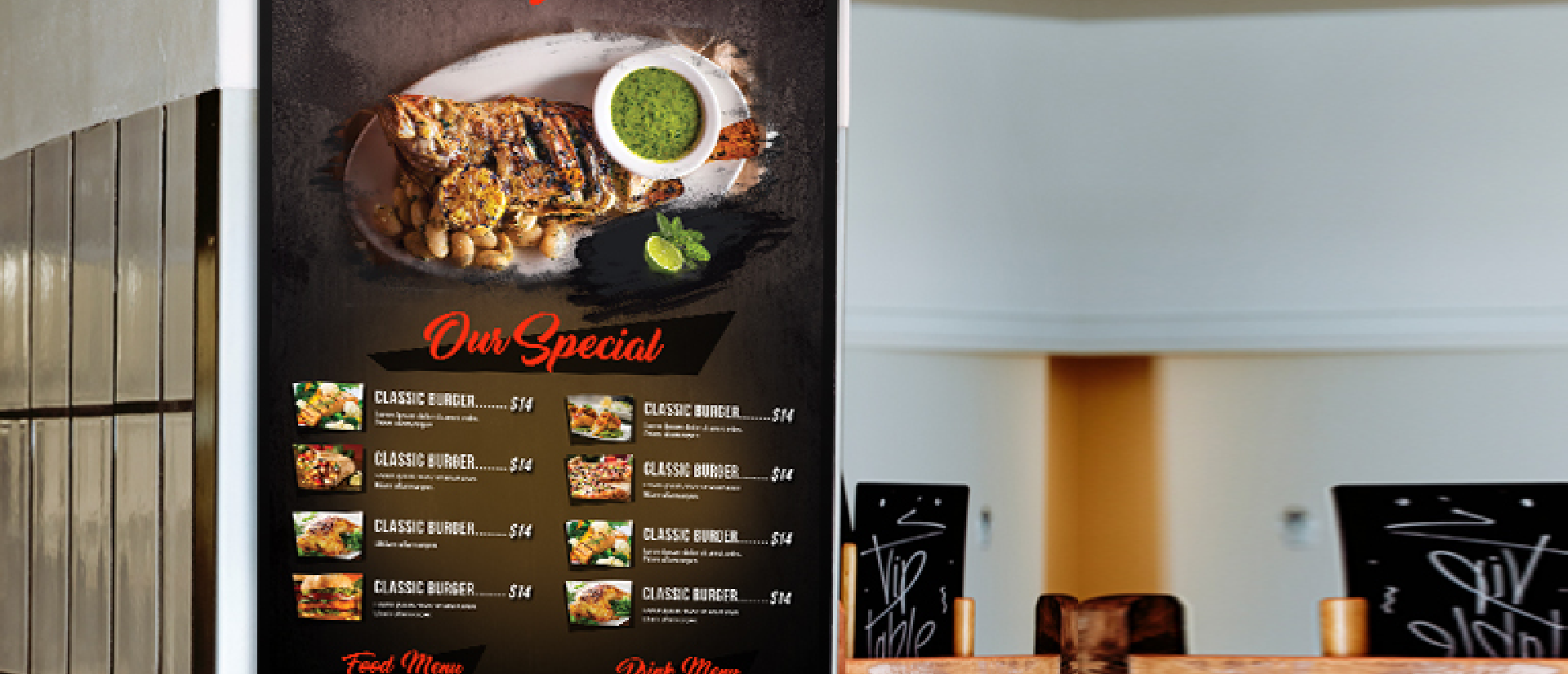
Yes, digital signage works in fine-dining and luxury hotel settings when the templates are designed for it. Pickcel supports full brand-custom visual templates and 4K content, so the on-screen presentation can match a property’s existing print and plating aesthetic rather than looking like a quick-service kiosk. Hotel F&B managers who assume digital signage means a fast-food-style menu board are picturing a generic stock template, not a brand-customized one. Properly designed, a wine list or tasting menu on screen reads as a deliberate part of the dining experience, not a budget shortcut.
What hotel F&B revenue tells us about the stakes
Food and beverage is a meaningful share of total hotel revenue at full-service and luxury properties, alongside rooms revenue. Hospitality research firms such as STR and CBRE Hotels track F&B as a distinct revenue category in their hotel performance benchmarking. The exact share varies by property type and market, but the pattern holds across the industry: F&B is not a side operation, it is a revenue center that depends on accurate, fast-changing menu and pricing communication at the point of sale.
Hotel F&B teams that move from printed daily menus to scheduled digital displays consistently report time savings on the update process itself, since one change in the CMS replaces a reprint-and-distribute cycle across every outlet.
Pickcel supports this scale of operation today across more than 9,000 businesses, 150,000-plus screens, and 70-plus countries, including hospitality groups managing multiple F&B outlets per property.
Frequently Asked Questions
What is digital signage for hotel restaurants?
How can hotel F&B teams update daily menus and specials on digital screens?
Can Pickcel manage digital signage across multiple hotel dining outlets from one platform?
Does digital signage work in a fine-dining or luxury hotel restaurant environment?
How does hotel restaurant digital signage help increase upsell and F&B revenue?
Ready to run every hotel F&B outlet from one screen?
If your hotel group is managing F&B signage outlet by outlet today, request a demo to see how one CMS handles every dining outlet and event space on the property. Or explore the platform to try the scheduling workflow yourself.