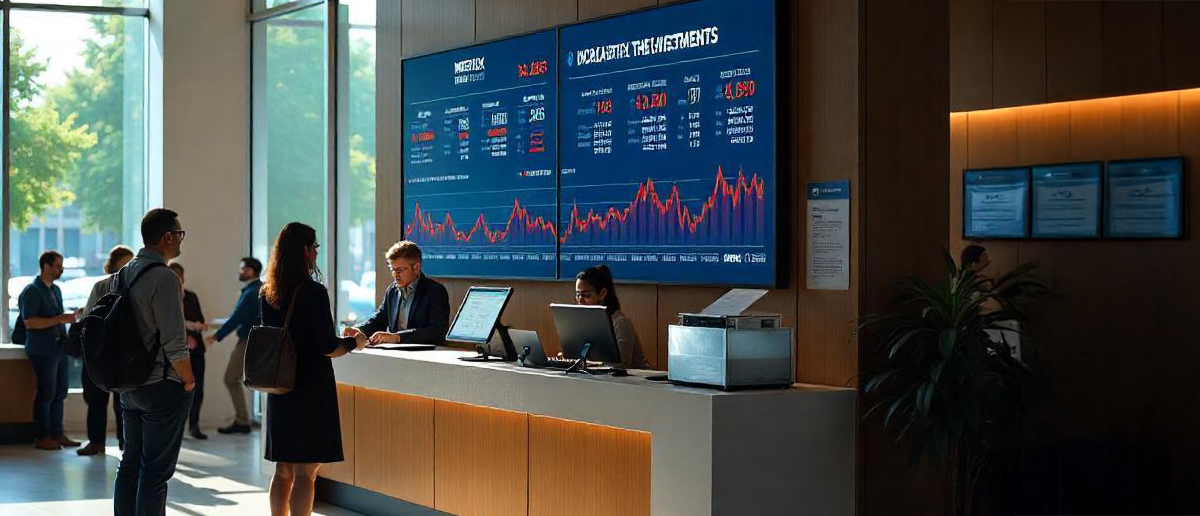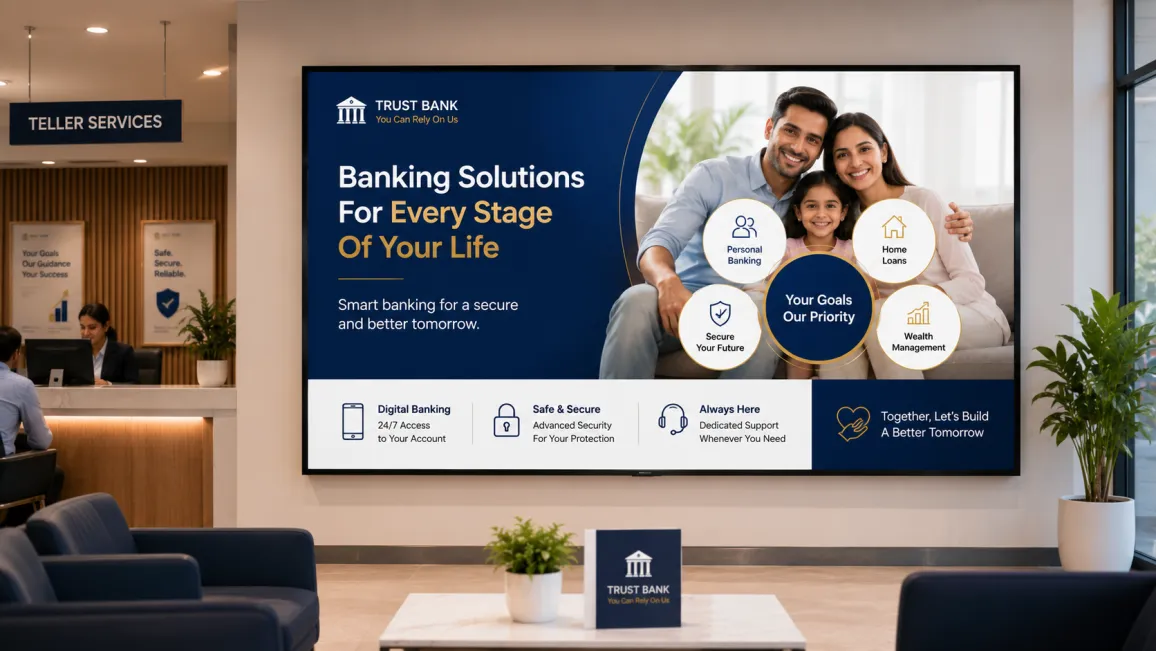
Bank branches are in the middle of a significant reinvention. Transaction volumes that once defined branch success have moved to mobile apps and online banking. What remains and what branches are being redesigned around is the high-value, relationship-driven interaction: mortgage advice, investment planning, business banking, complex problem resolution.
This shift has made in-branch customer experience a strategic priority. Banks are investing in the physical environment as a differentiator, not a cost centre to be minimised. The technologies powering this reinvention span AI-assisted advisors, digital onboarding, and branch displays that deliver real-time financial information. Understanding how each technology layer contributes helps financial services leaders make better investment decisions and avoid the common trap of optimising digital channels while leaving the physical branch experience behind.
- Bank branches are shifting from transaction centres to advice and relationship hubs.
- Digital signage closes the physical-digital experience gap inside the branch.
- Pickcel is SOC 2 Type II and ISO 27001 certified.
What is digital transformation in financial services?
Financial services digital transformation is the adoption of digital technologies across banking, insurance, and financial services to improve customer experience, increase operational efficiency, and meet evolving regulatory requirements. It spans mobile banking, AI-assisted service delivery, cloud infrastructure, data analytics, and process automation. For retail banks, it also includes the physical branch environment. Digital displays, queue management systems, and omnichannel integration are reshaping how customers encounter the brand in person.
The term covers a wide range of initiatives, from migrating core banking systems to the cloud to deploying AI chatbots in customer service. At the branch level, it includes both front-of-house changes, covering what customers see and interact with when they arrive, and back-office modernisation, covering how staff access information, manage queues, and receive communications from head office.
For financial services leaders, the key point is that digital transformation is not a single project. It is a direction of travel that requires coordinated investment across technology, operations, and customer experience at the same time. The institutions seeing the strongest results treat physical and digital touchpoints as a single system rather than separate budgets.
The key technologies driving financial services digital transformation
Banks and financial institutions are investing across six distinct technology areas. Each addresses a different part of the customer or operational journey.
Mobile banking and self-service. The foundation of financial services digital transformation is the shift to mobile-first banking. Customers complete routine transactions entirely through apps: balance checks, transfers, bill payments, and account management. The branch visit becomes reserved for what apps cannot deliver well, primarily complex decisions that benefit from human guidance. According to Forrester’s State of Digital Experiences in Banking, 2025, US banking customer experience quality declined for the third consecutive year, with mobile experiences under scrutiny for falling short of rising customer expectations.
AI and intelligent service delivery. Banks are deploying AI across customer service, fraud detection, credit decisioning, and personalised product recommendations. These systems improve response speed and reduce operational cost, while freeing branch staff to focus on relationship-driven work. A branch advisor who spends less time on basic queries spends more time on mortgage and wealth planning conversations.
Cloud infrastructure. The migration of core banking systems from on-premise servers to cloud platforms reduces IT overhead, improves system reliability, and creates the data architecture necessary for real-time decision-making across channels. It also enables branch networks to receive centralised content updates instantly, including through enterprise-scale digital signage management .
Data analytics. Customer data analysis drives personalisation across every channel, from the products displayed on a branch screen to the rate offer presented through the mobile app. Data analytics also powers regulatory reporting, risk management, and the identification of customers most likely to respond to a specific financial product at a specific point in their financial life.
Process automation. Repetitive back-office processes such as loan origination, KYC verification, and compliance checks are being automated through workflow tools and robotic process automation. This reduces processing time, decreases human error rates, and allows compliance teams to focus on complex cases rather than routine document handling.
In-branch digital experience. The physical branch is the final pillar and often the one that receives the least investment relative to its strategic importance. According to a consumer study by Accenture, 64% of bank customers will visit a branch when they cannot resolve an issue through digital channels. The branch is not disappearing. It is becoming the setting for high-trust, high-value conversations, and the in-branch experience shapes the customer’s perception of the bank’s overall competence and modernity.
This is where digital signage becomes a relevant technology decision for banking leaders.
How digital signage supports financial services digital transformation
Digital signage is the physical layer of a bank’s digital transformation strategy. Where mobile apps handle the customer’s digital interaction before they arrive and after they leave, the branch display network shapes the experience during the visit itself. A branch that looks and feels modern communicates brand credibility before an advisor says a word.
Digital signage plays five specific operational roles in financial services branch environments. For a deeper look at digital signage use cases for banks and credit unions , see the dedicated use cases guide.
Product and rate display. Branch screens display live interest rates, mortgage rates, savings products, and investment options, updated centrally and pushed to hundreds of branches simultaneously. When rates change, all screens reflect the update within minutes. The alternative is printed rate cards that may be days or weeks out of date, a compliance risk and a poor customer experience in one. With a centrally managed CMS, the rates a customer reads on the wall match exactly what the advisor will quote at the desk. For more on how US bank branches are deploying in-branch digital signage , including rate display configurations, see the US branch guide.
Queue management and wait time communication. Queue visibility is a consistent driver of in-branch customer satisfaction. Screens displaying live queue position, estimated wait times, or relevant content while customers wait reduce the perceived time spent in the branch. Financial institutions that deploy queue management digital signage for bank branches alongside digital signage typically report improvement in customer wait experience scores on branch satisfaction surveys.
Compliance and regulatory notices. Financial institutions operate in one of the most regulated environments of any industry. Required disclosures, regulatory notices, and compliance communications need to appear in specific locations on specific schedules, with evidence of display. A digital signage CMS with scheduled publishing, role-based access control, and an audit trail of what was displayed, when, and on which screens addresses this requirement. Compliance-sensitive content can be locked so that no branch manager can accidentally overwrite or remove it.
Financial literacy content. Branches positioning themselves as advisory hubs benefit from content that educates. Explainer videos on retirement planning, ISA allowances, mortgage affordability, or market movements give customers useful context during their visit. An informed customer makes faster, more confident decisions. For banks shifting their branch role toward relationship banking, the content on the walls is part of that repositioning.
Branch employee communication. Digital transformation includes the employee experience alongside the customer-facing environment. Back-of-house screens deliver KPI dashboards, shift briefings, policy updates, and emergency communications to branch staff, replacing email chains that many frontline staff do not have reliable access to at the counter. Head office can communicate operational changes to 200 branches in minutes rather than cascading updates through a management chain.
All five functions are managed through a single content management system. Pickcel’s digital signage platform for banks and financial institutions uses a cloud-based digital signage platform that allows a head office marketing or operations team to manage all branch screens centrally, with each branch running localised content in designated zones. A bank operating 200 branches does not need a local administrator at each site.
Security and compliance for financial services digital signage
Pickcel holds SOC 2 Type II and ISO 27001 certifications , the minimum security baseline required for enterprise deployment in regulated financial services environments. For IT teams at financial institutions conducting vendor due diligence, these credentials are the first filter before any broader evaluation proceeds.
SOC 2 Type II verifies that Pickcel’s systems maintain the availability, confidentiality, and security controls described in its trust services criteria, and that these controls have been independently audited over a continuous review period. It is not a point-in-time snapshot but an ongoing verification of operational security practice.
ISO 27001 is the international information security management standard. It confirms that Pickcel operates a formal information security management system with documented risk treatment, policy enforcement, and regular independent review. It is the standard recognised across banking, insurance, and government procurement processes internationally.
A financial services deployment of Pickcel typically requires the following configuration:
Role-based access control: The central marketing team controls global templates and brand-level content. Branch managers control only local content zones. Compliance manages scheduled regulatory content with publishing locks. IT manages device groups, system access, and user provisioning.
Audit trail: Every content change, scheduling action, and screen state is logged with timestamps and user IDs. Regulatory audits can produce a full display history for any screen, on any date.
Data residency options: For institutions with data sovereignty or residency requirements, Pickcel supports deployment configurations that meet local data governance obligations.
For IT managers evaluating digital signage software as part of a broader digital transformation initiative, these are the capabilities that move a vendor from marketing’s wish list to the IT project shortlist.
Frequently Asked Questions
What is digital transformation in financial services?
How do banks use digital signage as part of their branch digital transformation strategy?
Is Pickcel secure enough for use in regulated financial institutions?
Can Pickcel display live interest rates and financial product information on branch screens?
What is the role of in-branch digital signage in a bank's customer experience strategy?
What technologies are driving digital transformation in financial services?
How do bank branches use digital displays to improve the in-branch customer experience?
How much does digital signage software cost for a financial services branch network?
Ready to bring your branch network into the digital experience?
If you want to see how Pickcel runs across a financial services branch network, request a demo to discuss a deployment with a financial services specialist. Or get started free and explore the CMS directly.