CORPORATE
.
12 min read
.Published June 12, 2026.Updated June 12, 2026
A Practical Guide to Employee Experience Management
A complete guide to employee experience management: five pillars, key metrics, and how to reach every employee including deskless workers. By Pickcel.
Deblina Chatterjee
Author at Pickcel
TL;DR
Employee experience management (EXM) is the discipline of designing, measuring, and improving every touchpoint an employee has with the company — not a software category.
A complete EXM strategy rests on five pillars: communication, environment, recognition, onboarding, and technology.
Pickcel extends EXM reach to deskless workers through screen-based communication in shared physical spaces.
Most organisations have an HRIS, an intranet, and a pulse survey platform. Many still see attrition rise and engagement scores stagnate. The problem is rarely the tools. It is the absence of a coherent discipline connecting them. That discipline is employee experience management.
At a Glance
Employee experience management (EXM) is the ongoing organisational discipline of designing, measuring, and improving every touchpoint an employee has with the company, from the first day of onboarding through to exit.
1
EXM is a management practice, not a software category; it spans HR, internal communications, and operations
2
Pickcel supports employee communication for 9,000+ businesses across 150,000+ screens in 70+ countries
Employee experience management is the practice of designing, measuring, and continuously improving every interaction an employee has with the organisation, covering the physical work environment, communication, tools, culture, and leadership, from recruitment through to exit.
Employee experience management is a discipline that covers every aspect of how an employee interacts with an organisation, including culture, tools, physical environment, communication, and leadership. It is broader than employee engagement, which measures how an employee feels at a point in time.
It is distinct from employee engagement. Engagement is a metric, a measure of how motivated and connected an employee feels right now. EXM is the management system that produces the conditions for that engagement. Surveying engagement without addressing the underlying experience design rarely improves either.
Why EXM Matters in 2026
Employee experience management matters because the cost of neglecting it is direct. When employees feel disconnected, uninformed, or undervalued, attrition rises, productivity drops, and new-hire timelines stretch. Organisations that manage experience deliberately retain more people and spend less replacing them.
The challenge intensifies for organisations with distributed or deskless workforces. In manufacturing plants, retail chains, and hospital networks, the majority of employees do not sit at desks, do not use corporate email as a primary communication channel, and cannot access an intranet during a shift.
Gallup’s State of the Global Workplace 2024 report finds that a majority of employees in most markets are either not engaged or actively disengaged at work. For organisations with deskless workers, the problem compounds. Of the 2.7 billion deskless workers worldwide (Workplace from Meta, 2022), a significant proportion are unreachable through corporate email and intranet tools designed for desk-based employees, regardless of how much the organisation invests in engagement programmes.
The 5 Pillars of Employee Experience Management
A complete EXM strategy addresses five connected dimensions. Each pillar reinforces the others; weakness in one undermines the system as a whole.
Pillar 1: Communication
Effective EXM begins with communication: the right message reaching the right employee through the right channel, at the right time. For distributed workforces, this means a channel mix that includes the physical spaces where work actually happens.
Communication failures in organisations are rarely a content problem. Managers usually know what needs to be said. The failure is delivery: messages go unread, shift workers miss updates, multilingual teams receive information in one language only. A sound EXM communication strategy maps each employee group to the channels they use and monitors whether messages reach their intended audience.
Employee Type
Typical Channels
Average Message Reach
Desk-based employees
Email, intranet, desktop notifications
20–25% (email open rate)
Deskless / frontline workers
Digital signage, SMS, WhatsApp
Up to 94% within 2 hours (Pickcel)
Mixed workforce
Multi-channel: screens + mobile + email
Higher combined reach across segments
Pillar 2: Physical and Digital Environment
The physical and digital environment shapes employee experience before a single word is spoken. Workspace design, screen-based communications, ambient information displays, and the tools employees interact with daily all contribute to how included, informed, and valued a person feels.
For desk-based employees, digital environment means the tools on their computers: HRIS, project management, internal chat. For deskless and frontline workers, it extends to what they can see and access on the floor, in break rooms, at warehouse entry points, and in clinical corridors. Pickcel’s digital signage software
delivers real-time announcements, recognition content, and operational updates to screens in shared physical spaces, reaching workers without requiring them to open an app or carry a device.
Pillar 3: Recognition and Feedback
Recognition and feedback form the two-way channels of employee experience management. Recognition signals that contribution is seen; feedback gives employees and the organisation the data needed to improve.
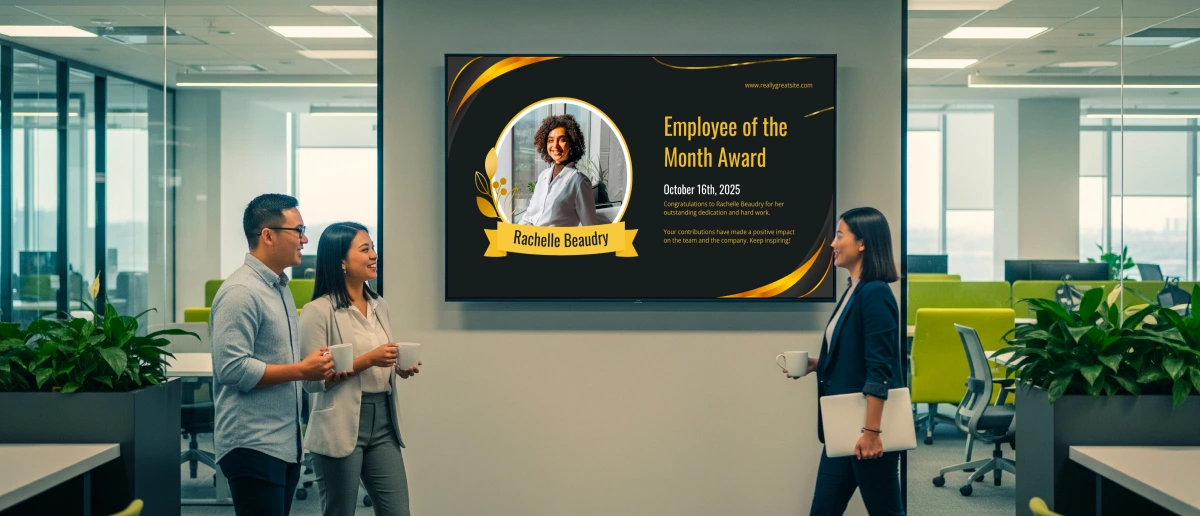
Regular, visible recognition does not require a formal awards programme. A screen showing an employee’s name alongside a safety milestone or service anniversary achieves the same psychological effect at lower cost and higher frequency. Structured feedback channels, whether formal surveys or informal mechanisms, create the data that keeps EXM responsive over time. For a structured approach to recognition and engagement, see our guide to best employee engagement strategies
.
Pillar 4: Onboarding and Development
Onboarding is the first live test of employee experience management. How a new hire’s first days are structured signals, more directly than any mission statement, what the organisation actually values. Development pathways beyond onboarding reinforce that investment in the employee is ongoing.
HR researchers and workforce practitioners consistently identify the first 90 days as a critical period for 12-month retention. Organisations that structure this period to clearly introduce culture, communication tools, and role expectations tend to see faster time-to-productivity and stronger first-year retention.
Pillar 5: Tools and Technology
The tools employees use to do their work are a central part of the employee experience. Friction-heavy, poorly integrated, or inaccessible technology degrades the experience in ways that recognition and culture programmes cannot compensate for.
Technology selection for EXM should be evaluated not only on features but on accessibility: can every employee group use this tool in their actual work context? Deskless workers need solutions that do not assume desk or device access. Multilingual teams need platforms that support multiple languages without additional manual effort from the HR team.
How Digital Signage Fits Into EXM
The hardest part of employee experience management is reaching employees who do not sit at desks.
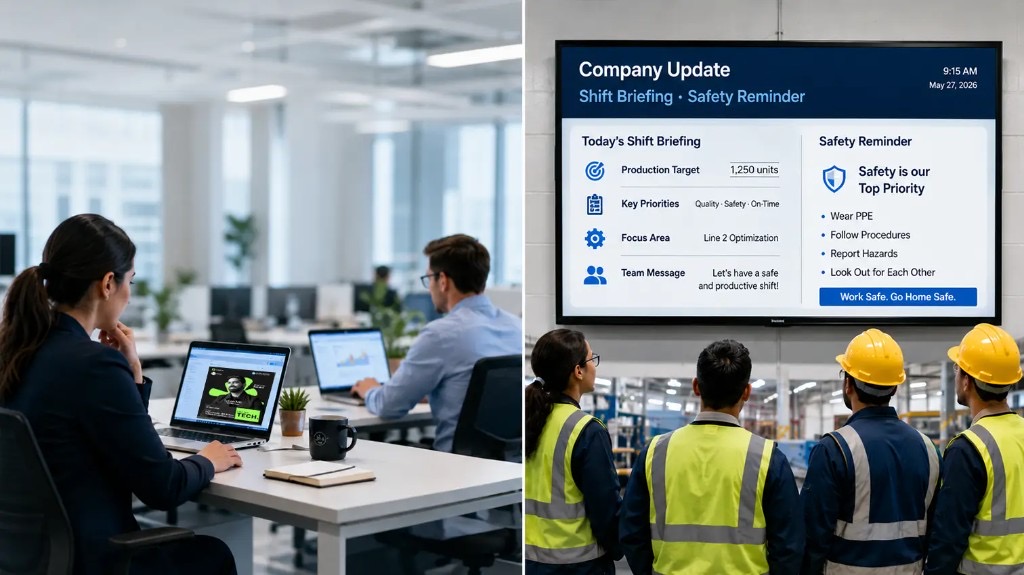
Digital signage fills the deskless worker gap in EXM. Pickcel delivers real-time announcements, safety alerts, recognition content, and shift schedules to shared screens across manufacturing floors, hospital corridors, retail stockrooms, and transport hubs, reaching workers who never see an internal email.
Manipal Hospitals uses Pickcel across 250+ displays in Bengaluru and New Delhi to communicate with clinical and non-clinical staff across multiple shifts and departments. At Amrita University, Pickcel screens reach students and staff with announcements, schedules, and institutional updates across multiple campuses. Across multi-channel deployments combining digital signage with SMS and other employee communication channels, Pickcel reports 94% message reach within two hours, measurably higher than the 20–25% average open rate of internal email.
The role of digital signage in EXM is not to replace HRIS, engagement platforms, or intranets. It is to extend their reach into the physical spaces where a significant portion of the workforce spends most of their time. Explore the Pickcel employee communication solution
for screen-based EXM, or read more about team communication tools
to understand how signage fits into a broader communication stack.
Measuring Employee Experience: Key Metrics
Employee experience management is measurable. Organisations that treat EXM as a qualitative endeavour miss the feedback loops needed to improve it. The most useful EXM metrics track both how employees feel and what the organisation is doing to reach them.
Key metrics include:
eNPS (Employee Net Promoter Score): Tracks how likely employees are to recommend the organisation as a place to work. Collected quarterly, eNPS provides a directional signal of overall experience quality.
Message reach rate: For organisations using multi-channel communication tools, message reach rate measures what percentage of the intended audience received a given communication. Low reach is an early warning that communication infrastructure needs attention.
Absenteeism rate: Higher-than-average absenteeism correlates with disengagement. Tracked over time and disaggregated by team or location, it can surface EXM problems before they escalate.
Time-to-productivity for new hires: Prolonged ramp time frequently indicates onboarding and communication gaps in the EXM system.
These metrics are most useful when reviewed by team, location, or employee group rather than as a single organisation-wide average.
Frequently Asked Questions
What is employee experience management?
Employee experience management (EXM) is the organisational discipline of designing, measuring, and continuously improving every touchpoint an employee has with the company, spanning communication, physical and digital environment, recognition, onboarding, and technology. EXM is broader than employee engagement. Engagement is an outcome: a measure of how motivated and connected an employee feels. EXM is the management system that produces that outcome. Organisations without an explicit EXM discipline often manage engagement reactively, responding to survey data after disengagement has already set in. EXM shifts the approach to proactive design: building the conditions for good experience before problems emerge. It requires coordination across HR, internal communications, operations, and technology functions. For further reading on the tools that support this work, see our guide to employee experience platforms
.
What is the difference between employee experience and employee engagement?
Employee experience is the sum of all interactions an employee has with an organisation, covering the physical workspace, tools, communications, and culture. Employee engagement measures how motivated, connected, and committed an employee feels as a result of those interactions. The distinction matters because it changes what you do with the data. Engagement surveys tell you what employees currently feel. EXM tells you what conditions produced that feeling and which interventions are most likely to improve it. A drop in engagement scores is a symptom; EXM is the diagnostic framework that identifies the root cause. Organisations that focus exclusively on engagement measurement without addressing experience design tend to see survey fatigue and diminishing returns from pulse programmes over time.
What are the key pillars of an employee experience management strategy?
A complete EXM strategy rests on five pillars: communication (right message, right channel, right person), physical and digital environment (including screen-based communications for deskless workers), recognition and feedback, onboarding and development, and tools and technology. Each pillar addresses a different dimension of the employee’s relationship with the organisation. Communication ensures employees receive what they need to do their jobs and feel informed. Environment covers the spaces and tools they work within. Recognition creates visible appreciation and two-way dialogue. Onboarding and development signal long-term investment in the employee. Technology reduces friction throughout the working day. Weakness in any pillar affects the whole, which is why EXM works best as a coordinated discipline rather than a collection of separate HR programmes.
How do you measure employee experience?
Employee experience is measured using a combination of quantitative and qualitative signals: eNPS for overall sentiment, message reach rate for communication effectiveness, absenteeism rate as a proxy for disengagement, and time-to-productivity for new hires to evaluate onboarding quality. No single metric captures the full picture. The most effective EXM measurement frameworks combine periodic surveys with always-on operational data such as absenteeism rates, voluntary turnover by department, and communication reach statistics. Disaggregating metrics by team, location, or employee group reveals where experience breaks down, which is more actionable than a single organisation-wide number. For organisations using digital signage or multi-channel communication tools, message reach rate is a particularly useful real-time indicator of how effectively the workforce is being reached.
How does digital signage contribute to employee experience management?
Digital signage extends employee communications into the physical spaces where deskless and frontline workers spend their shifts. Pickcel screens deliver real-time announcements, shift schedules, safety alerts, and recognition content to employees who do not use corporate email or intranet tools during their working day. For manufacturing plants, retail chains, hospitals, and logistics networks, a significant proportion of the workforce is unreachable through desk-based communication channels. Pickcel solves this without requiring employees to download an app or carry a device. Content is updated remotely in real time, scheduled to display at relevant shift times, and tailored by location or department. Learn more about the Pickcel employee communication solution
or explore the best internal communication tools
for HR and comms teams.
What tools are typically used for employee experience management?
EXM typically draws on a combination of: HRIS platforms (such as Workday or SAP SuccessFactors) for HR data and workflows; engagement platforms for surveys and sentiment tracking; internal communication tools for multi-channel messaging; and physical communication channels such as digital signage for reaching deskless and frontline workers. The specific toolset depends on workforce composition. Desk-based workforces are well-served by HRIS, intranet, and email platforms. Mixed or deskless-heavy workforces need additional channels that reach employees in shared physical spaces: break rooms, production floors, warehouse entry points, clinical corridors. Digital signage integrates with existing EXM stacks without replacing them; it fills the channel gap rather than duplicating existing tools. For a broader comparison of internal communication options, see our guide to team communication tools
.
How can small and mid-sized businesses implement EXM without a large HR team?
Small and mid-sized businesses can implement employee experience management incrementally, starting with the two highest-impact pillars: communication and recognition. A structured communication calendar, a consistent onboarding process, and basic screen-based communication for frontline workers create a measurable EXM foundation without requiring a dedicated EXM function. The assumption that EXM requires an enterprise HR team and a large technology budget is common and largely incorrect. The five pillars can be addressed at different scales. A structured onboarding checklist and a consistent communication rhythm cost little to implement. Digital signage at a single site can reach every employee on shift without requiring individual device ownership. Pickcel’s plans scale from single-screen deployments to global multi-location networks. For practical examples in distributed workforces, see our manufacturing employee engagement blog
.
What is the ROI of investing in employee experience management?
The return on investing in EXM comes through reduced attrition, lower recruitment costs, faster time-to-productivity for new hires, and improved operational performance. Organisations that manage employee experience deliberately consistently see lower voluntary turnover than those managing it reactively. Voluntary attrition is the most direct cost lever. Replacing an employee typically costs the equivalent of several months of that employee’s salary when recruitment, onboarding, and ramp-up costs are accounted for. Reducing annual attrition by even a small percentage across a workforce of several hundred people produces significant direct savings. Beyond attrition, improved employee experience correlates with stronger customer satisfaction, higher output quality, and fewer safety incidents, particularly in manufacturing and healthcare environments where communication reliability directly affects operational outcomes.
Deblina Chatterjee is part of the marketing team at Pickcel, contributing to blogs across a range of topics related to digital signage and business use cases. She focuses on simplifying ideas and highlighting practical, real-world applications.
Pickcel supports the physical communication layer of EXM, reaching employees in shared spaces where desk-based tools cannot. Certified to enterprise security standards (SOC 2 Type II and ISO 27001), Pickcel scales from single-site deployments to global multi-location networks.