
Mar 9 2026

16 min read
March 16, 2026
11 min read


ALL
Internal Communications
When Gallup surveyed more than 128,000 employees across 160 countries for its State of the Global Workplace 2024 report, the headline finding was difficult to ignore: only 21% of employees are actively engaged at work, while 62% are disengaged. That is not a hiring problem. It is a communication problem.
Most organizations communicate extensively — at the top. Strategy decks, all-hands presentations, leadership newsletters. But by the time a message reaches the nurse on ward three, the cashier at register five, or the machine operator starting the early shift, it has either passed through three layers of management or not arrived at all.
Digital signage for internal communication addresses this directly. It puts real-time, role-relevant information in the physical spaces where employees actually work — without requiring a login, an open inbox, or a manager’s re-explanation.
Poor internal communication is not just frustrating — it is measurably expensive, and the cost compounds with every employee who stays uninformed.
A study by communications consultant David Grossman, published in Provoke Media (formerly the Holmes Report), surveyed 400 companies in the U.S. and U.K. and found that employee misunderstanding costs these organizations an estimated $37 billion annually — an average of $62.4 million per company per year. That figure covers missed instructions, repeated errors, compliance failures, and the accumulated misalignment between what leadership intends and what teams actually do.
The retention cost adds to this. According to the 2025 International Employee Communication Impact Study by YouGov and Staffbase — which surveyed 3,574 employees across six countries — 63% of employees who are unlikely to stay in their current role cite poor communication as a contributing reason.
The organizations most surprised by these gaps are often those that believe they already communicate well. They have enterprise intranets, internal newsletters, and quarterly town halls. And yet only 9% of non-desk workers in that same Staffbase study rate their internal communication as “very good” or better.
These three channels were designed for knowledge work done at a desk, with time available to read and respond. They perform adequately for that audience. Outside of it, they fail in predictable ways.
Email reaches employees who check their inbox. The nurse starting a 12-hour ward shift, the retail associate opening the store, and the production operator clocking in at 5 a.m. are not opening email first. They are moving.
Intranets require navigation. Even well-designed platforms see engagement fall sharply for employees not in roles that involve regular computer use. Information two clicks deep is, in practice, information that does not exist.
Printed notice boards present a different failure: they are static. Once pinned, they do not update until someone manually changes them. Outdated safety notices, expired event posters, and last month’s shift schedules accumulate. Eventually, employees stop reading them.
The shared limitation across all three is that they require an action from the recipient before the message is received. They are pull channels in environments where push is the only thing that works at scale.
Digital signage puts the message where the employee already is — removing the requirement for any action from the recipient. A screen in the break room, lobby, production floor, or hospital corridor delivers information passively, but effectively.
The productivity case for this approach is clear. A McKinsey Global Institute report on the social economy found that companies using connected technologies to improve internal communication see productivity gains of 20–25% among knowledge workers. The mechanism is not complex: when people know what is happening, they make better decisions with less back-and-forth.
Three capabilities make digital signage particularly effective for internal communication.
With a cloud-based CMS, content on any screen — across any number of locations — goes live the moment it is published. A policy change, a new safety protocol, a schedule update: it is visible on all relevant screens within minutes, without an email blast, a reprint, or a managerial relay.
Not every message belongs everywhere. Conference room screens can carry meeting schedules and room availability. Break room screens can show culture content, team achievements, and wellness updates. Production floor screens can display real-time safety metrics and operational targets. Content targeting by screen, zone, or building ensures the right employees see what is relevant to them.
Unlike a single email, a digital screen is persistent. Compliance reminders, safety procedures, and organizational values can remain visible as ambient content — refreshed regularly but continuously present. This is the quality that printed notice boards promise but cannot deliver once the content ages.
The value of digital signage for internal communication becomes concrete in specific environments. Here is how it plays out across four common contexts.
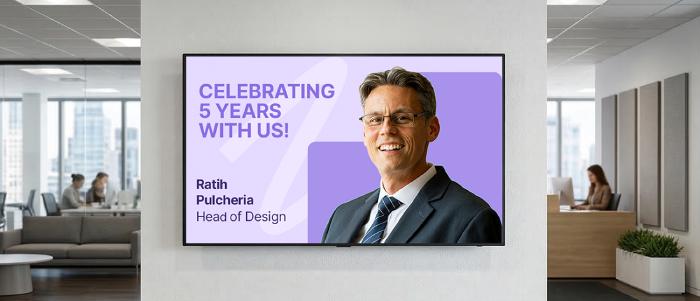
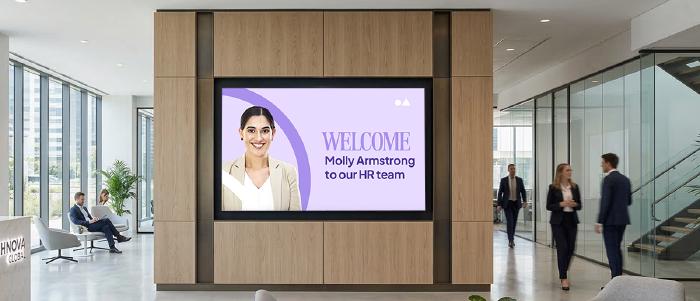
Corporate digital signage in office environments typically delivers highest impact through two use cases: employee recognition and organizational updates.
Lobby and common area screens surface monthly performance highlights, project completions, and team achievements — the kind of recognition that gets buried in email or mentioned once in a meeting and forgotten. Over time, this builds a visible, consistent layer for culture without requiring anyone to attend a session or open a document.
Accenture deployed Pickcel’s corporate digital signage across its Indian offices to standardize internal communication at scale — delivering company-wide content while allowing individual locations to surface relevant local updates.
In hospitals and clinics, internal communication is not a productivity issue — it is a patient safety issue. Staff need reliable, timely access to protocol updates, infection control changes, and handover notes without those messages competing with clinical workflow.
Digital signage on nursing floors, near staff rooms, and in clinical corridors keeps compliance-critical content visible passively, throughout the shift. Emergency override functions push urgent messages to all screens instantly when conditions change.
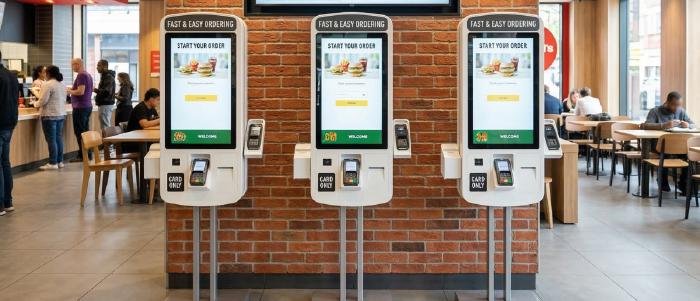
Retail and quick-service restaurant teams are among the hardest workforces to keep aligned. High turnover, split shifts, and minimal desk time mean that critical updates — a new promotion mechanic, a product recall, a pricing change — often do not reach the full team before the shift begins.
Back-of-house screens in staff rooms deliver the briefing before the shift. Front-of-house screens in service areas can show daily targets and live performance metrics, giving staff the operational context they need without a supervisor narrating every number.
Safety communication on a production floor has one usable format: visible, concise, and impossible to ignore. Digital signage for HR and operations teams in manufacturing environments typically includes incident-free day counters, PPE protocol reminders, and real-time environmental alerts.
These screens replace the notice board in locations where reading a pinned notice is neither practical nor reliable — and where the cost of missed information is measured in injuries, not inconvenience.
Most organizations can have their first internal communication screen live within hours. The deployment is fast; the value compounds over time.
Before adding screens, map which channels reach which employees and where the gaps are. If non-desk and frontline workers are routinely uninformed, digital signage closes that gap directly. If the underlying problem is content quality, the technology will amplify the problem, not solve it.
A lobby screen, a break room screen, and one floor-level screen — production, sales floor, or clinical corridor — give you coverage across the majority of your workforce. Start there. Measure awareness and expand.
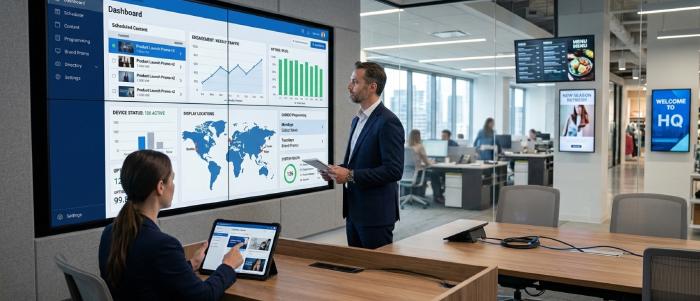
The most common failure mode for internal communication screens is stale content. Assign specific teams or individuals ownership of each screen zone. Set a review cadence — weekly for operational content, monthly for culture and values. A multi-channel employee communication platform lets you manage all screens and locations from a single dashboard, making it practical to maintain freshness at scale.
Internal communication screens are infrastructure, not a campaign. Useful success metrics include employee awareness of key initiatives (measured via pulse surveys), safety protocol compliance rates, and qualitative feedback from team leads. Establish a baseline before launch so you can demonstrate the impact clearly after.
The tools most organizations use for internal communication have not kept pace with how their workforces actually operate. Email and intranets serve desk-based employees reasonably well. For everyone else — the majority of the workforce in retail, healthcare, manufacturing, hospitality, and education — those channels are unreliable at best and invisible at worst.
Digital signage for internal communication is not a media channel. It is infrastructure for organizational alignment. When information reaches people in the places they work, in a format they can absorb without interruption, communication stops being a periodic management effort and becomes a continuous, ambient function of the workplace itself.
The organizations that close this gap do not just improve their communication scores. They see it in their safety records, their retention numbers, and ultimately in the quality of decisions being made at every level of the business.
Digital signage places real-time, role-relevant messages directly in the physical spaces where employees work — lobbies, break rooms, production floors, and clinical corridors. Unlike email or intranets, it requires no action from the recipient. This makes it especially effective for non-desk and frontline workers who rarely access a digital inbox during their shifts.
The most effective content categories for workplace digital signage are operational updates (shift changes, policy reminders, compliance notices), employee recognition (achievements, milestones, team highlights), real-time metrics (production targets, safety counters, daily goals), and emergency or safety alerts. Content should be concise, visual, and readable within three to five seconds of glancing at the screen.
Email is pull communication — the recipient must choose to open it. Digital signage is push communication — it displays information in the employee’s environment without requiring any action. This difference matters most for frontline and non-desk workers, who may check email infrequently or not at all during a shift. Digital signage also persists; a message on a break room screen remains visible throughout the day rather than competing for inbox attention.
Yes — and this is precisely where digital signage outperforms most other internal communication channels. Screens placed in high-traffic areas (warehouses, hospital corridors, restaurant service areas, retail stockrooms) reach employees during natural movement and breaks, without requiring device access. The 2025 Staffbase and YouGov employee communication study found that only 9% of non-desk workers rate their current communication quality as very good — digital signage directly addresses this gap.
With a cloud-based platform, an organization can have its first screen live in under an hour — from account setup to published content. Scaling to multiple locations requires no additional infrastructure beyond the screens themselves and network connectivity. Most mid-sized organizations complete an initial rollout across five to ten locations within two to four weeks, depending on hardware procurement timelines.
Mar 9 2026
16 min read

Mar 6 2026
4 min read
Mar 6 2026
6 min read
Mar 5 2026
4 min read
Take complete control of what you show on your digital signage & how you show it.
Start Free Trial Schedule My Demo