

Dec 24 2025

10 min read
August 28, 2025
8 min read


ALL
GENERAL
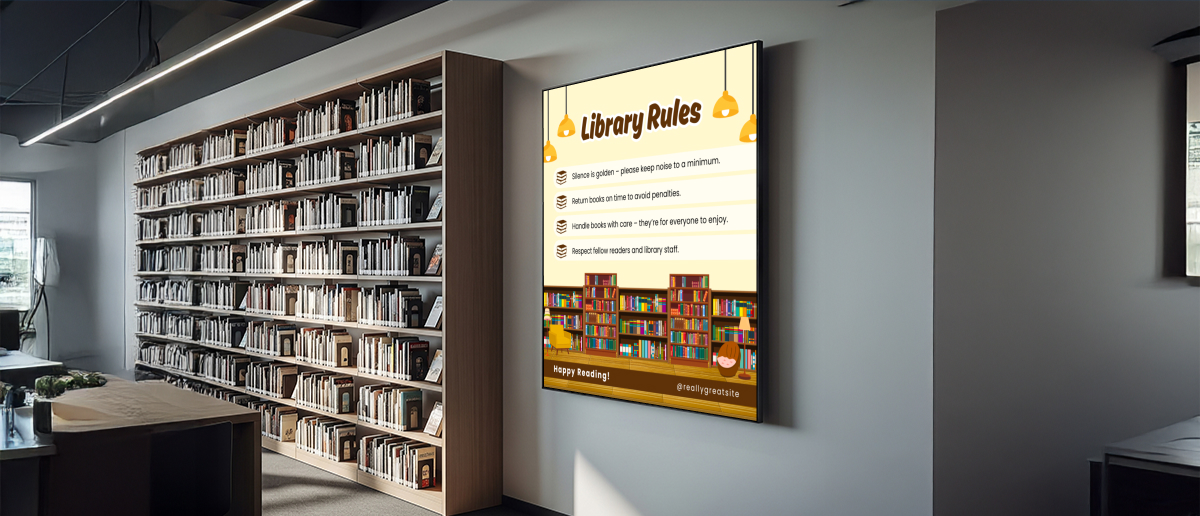
When thinking of libraries, many still picture quiet sanctuaries of book spaces for study, research, and reflection.
But today’s modern libraries function as dynamic community hubs, providing not just access to books but also technology, learning opportunities, cultural programming, and essential services for people of all ages.
Most U.S. public libraries are funded by local or state governments, supplemented by grants, and supported by non-profit foundations. Classified primarily as 501(c)3 entities, they operate under tight annual budgets that leave little room for inefficiency.
This financial reality means libraries must optimize limited resources while meeting community needs.
Digital signage is helping libraries future-proof their role as essential public institutions by modernizing communication, cutting operational costs, and creating inclusive, accessible environments that meet the needs of today’s digital-first audiences.

For the longest time, libraries have relied on bulletin boards and paper posters to share news, events, and announcements. But as patron behavior shifts toward instant information in a digital-first environment, these static methods create more problems than solutions.
Traditional library boards depend on paper flyers and static text. The problem is that they fail to capture attention in today’s digital environment.
The impact is low engagement; patrons overlook events, programs, and services, and libraries see wasted staff effort with minimal community reach.
Managing bulletin boards is a time-consuming process, with staff repeatedly updating, removing, and replacing flyers across multiple sections or locations.
This creates an operational bottleneck and takes time away from higher-value tasks like programming or patron support. Similar to the challenges organizations face with workplace communication.
With a digital signage software like Pickcel, USA libraries can update all screens from a single dashboard, schedule content in advance, and instantly broadcast urgent announcements, eliminating delays and reducing manual effort.
Libraries often need to share urgent updates like event cancellations or changes in hours. Static boards are too slow, forcing staff to swap notices manually and leaving patrons with outdated information. This causes confusion, missed events, and frustration.
Printed flyers and posters lead to recurring costs in materials and staff time while generating significant paper waste. This not only strains already limited budgets but also conflicts with sustainability goals.

Digital signage is modernizing how libraries communicate, it helps them serve their communities more effectively while reducing inefficiencies and future-proofing their operations.
Digital displays use motion, color, and dynamic content to capture attention, and understanding digital signage performance optimization can help libraries refine their content strategies for maximum engagement.
Digital signage software in USA libraries can be used to showcase workshops, promote reading programs, and keep patrons informed through vibrant, multimedia displays that capture attention far better than traditional bulletin boards.
Digital signage streamlines content updates by enabling staff to instantly push content across multiple screens, whether within a single branch or across an entire library network.
Urgent alerts, such as closures or emergency notices, can be displayed immediately, eliminating communication gaps. Compared to repetitive manual updates on bulletin boards, this streamlined process saves staff time and significantly improves overall efficiency.
Printing flyers creates ongoing costs and waste. With cloud-based digital signage, libraries can update multiple screens instantly without printing, reducing material and labor expenses. Energy-efficient displays further cut operating costs, allowing savings to be redirected toward collections, facilities, and community programs, making libraries both financially and environmentally sustainable.
Libraries serve diverse communities and handle sensitive information, making security and compliance critical priorities. Modern digital signage security in USA locations demands robust access controls, encrypted content delivery, and tamper-proof systems that limit management to authorized staff only.
On-premises digital signage in USA institutions that follow strict IT governance rules offer complete control over deployment and data handling, ensuring communication remains reliable, secure, and fully aligned with institutional policies without external dependencies.

Rolling out digital signage in libraries is not just about placing screens. It requires a structured approach that ensures efficiency, security, and long-term value. Libraries can borrow from tried-and-tested visual communication strategy models used in workplaces.
The foundation of a successful rollout begins with selecting reliable hardware and media support. Implementing a digital signage player in USA libraries ensures smooth playback across different display types, from interactive kiosks to wall-mounted screens.
The right software platform lets staff manage all screens from one dashboard. With tools like scheduling, automated updates, and multi-location sync, libraries can save time, push urgent alerts instantly, and keep messaging consistent across every branch.
The deployment strategy determines how effective digital signage will be. Cloud-based systems make it easy to scale and manage multiple locations, while on-premise setups offer tighter control and compliance. Choosing the right model helps libraries balance flexibility, security, and reliability, ensuring screens consistently deliver the right message at the right time.
Strong security measures are essential for libraries. By limiting access to authorized staff and ensuring compliance with institutional policies, digital signage systems stay reliable, tamper-proof, and aligned with public trust expectations.
Libraries need clear policies for updates, monitoring, and performance checks. Using analytics, they can track engagement, measure impact, and refine content strategies for better results.
Even in today’s digital-first world, libraries remain crucial for learning, culture, and community connection.
Their role has evolved, and digital signage is now a core part of this change, essential in how libraries communicate, engage, and deliver services to increasingly diverse audiences.
It overcomes the limits of print boards, reduces operational strain, and creates space for more inclusive and sustainable communication. More importantly, it helps libraries stay relevant in an era where information must be dynamic, accessible, and immediate.
To maximize impact, it’s essential to measure outcomes, track event attendance, engagement levels, cost savings, and visitor satisfaction. With data-driven insights, libraries can refine their strategies, avoid common pitfalls, and prove the value of digital signage as more than just a communication tool, but as a long-term investment in community trust and impact.
Pickcel, a global leader in digital signage, provides reliable, scalable, and secure solutions that are simple to implement and easy to manage.
Whether cloud-based or on-premise, our platform makes it effortless for libraries to modernize communication, engage patrons, and be future-ready.
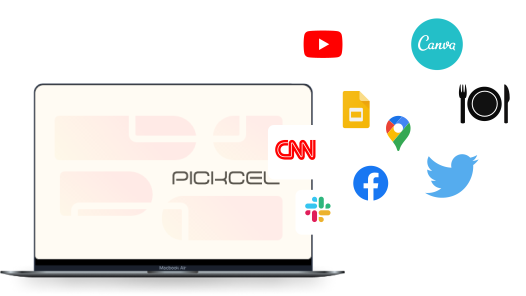
Libraries can showcase announcements, upcoming events, workshops, and new book arrivals while also highlighting digital resources like e-books and online databases. Multimedia content, including videos, graphics, and social media feeds, makes information engaging. Displays can also feature community news, internal staff communication, and even interactive quizzes or book reviews.
In multi-level or complex library layouts, digital signage simplifies navigation with dynamic maps, directories, and interactive kiosks. Patrons can quickly find sections, study spaces, or facilities without staff assistance.
Yes, interactive kiosks act as self-service points, helping patrons check out books, search catalogs, or renew memberships. They also provide wayfinding assistance, highlight library programs, and engage users with polls, trivia, or book trailers. By reducing queues and staff dependency, kiosks enhance efficiency and improve visitor experience.
Digital screens outside study rooms or meeting spaces can display real-time availability, letting patrons reserve spaces directly. They can also show equipment usage, policy reminders, or upcoming events. This ensures efficient resource utilization, minimizes scheduling conflicts, and reduces the need for staff intervention in routine tasks.


Dec 24 2025
10 min read

Dec 9 2025
14 min read

Nov 26 2025
7 min read
Nov 7 2025
11 min read
Take complete control of what you show on your digital signage & how you show it.
Start Free Trial Schedule My Demo