

Dec 24 2025

10 min read
October 21, 2025
9 min read


ALL
GENERAL
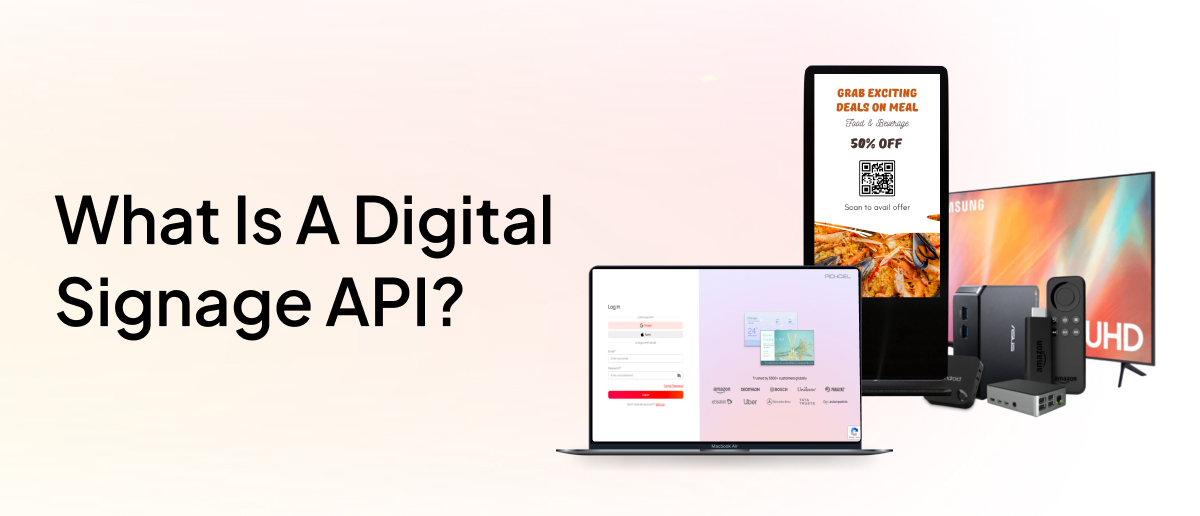
You’re walking past a retail store when a big screen catches your eye. It’s a digital ad promoting a huge deal on televisions. The message reads:
“LIMITED TIME: 50% OFF — GRAB YOURS TODAY!”
Tempted, you walk in.
But when you reach the aisle, there’s nothing there. The TVs are completely sold out and have been since the day before.
Instead of feeling excited, you’re now frustrated. You feel misled.
What was meant to be a compelling promotion ends up leaving a bad taste. It’s not just a wasted advertisement; it’s a negative brand impression.
The digital signage did its job by grabbing attention, but it didn’t deliver the right message at the right time.
And that’s the catch: attracting the customer isn’t enough if the information on the screen is outdated.
This is exactly where the digital signage API makes all the difference.
Before you scroll further, here's something worth checking out: a quick, practical read that shows why content synchronization is a game-changer for your brand.
For: Operations and marketing leads in small to mid-sized businesses using digital signage who want to automate updates, sync data across systems, and manage content centrally.
Before we get to know what a digital signage API is, let’s quickly cover what an API is.
An Application Programming Interface is like a translator between two programs. It lets them share data, send commands, and stay in sync, without needing a human in the middle.
There are two main types used in web development:
REST (Representational State Transfer): Fast, lightweight, and widely used, most modern apps rely on REST APIs.
SOAP (Simple Object Access Protocol): More complex and often used in older enterprise systems.
Most digital signage platforms today rely on RESTful APIs, which use standard web calls (like HTTP) and exchange data in easy-to-handle formats like JSON.
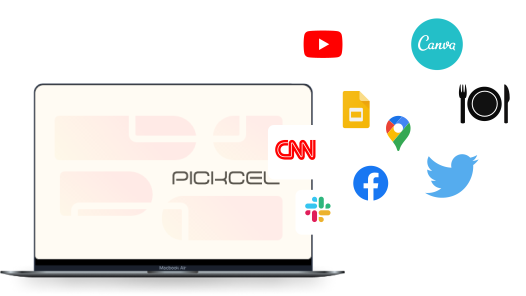
A digital signage API simply connects your digital signage software with other systems and data sources. Instead of displaying static, preloaded content, it reacts to triggers, pulls live data, and adapts to real-world conditions, making your screens dynamic and responsive.
You remember the retail store example from earlier? This is exactly how that situation could’ve been avoided. We have:
A chain of hardware stores is running a TV promotion across all its screens in every location. The digital signage was set up to push the same campaign everywhere.
But in 20 of those stores, the TVs had already sold out. The ERP system reflected this, but the signage didn’t. So customers kept seeing an ad for a product they couldn’t buy.
By connecting your signage system to your ERP or inventory platform using an API, you can make it react instantly. When the system detects that a store is out of stock, the ad disappears automatically. The screen can then switch to promoting any other available item.

APIs enable integration with internal systems like CRMs, ERPs, Power BI, or project management tools such as Jira or Asana. This allows screens to display live KPIs, operational updates, announcements, and recognition messages, without manual effort.
What Deployment Looks Like with Pickcel
AARCorp needed a way to keep global teams aligned with real-time operational and safety information. Pickcel integrated its digital signage system with Power BI and other internal data sources, enabling dashboards and safety updates to sync instantly across locations.
Key Benefits:
Unified visibility into performance and safety KPIs across sites.
Automated data refreshes without manual reporting cycles.
Increased employee awareness and engagement with live insights.
Analytix Business Solutions: as operations expanded, Analytix struggled to share updates and announcements across multiple offices efficiently. Pickcel signage software was integrated with Zoom, enabling company-wide broadcasts of live meetings and announcements on office screens
Key Benefits:
Seamless cross-location communication.
Instant company-wide updates without manual coordination.
Higher employee engagement with transparent, real-time communication.

Digital signage APIs connect directly with POS, ERP, and inventory systems to keep menu boards, promotions, and product availability up to date across locations.
What Deployment Looks Like with Pickcel
Amazon’s mall kiosks required instant campaign roll-outs across hundreds of retail locations. Pickcel’s API-connected CMS automated content synchronization, ensuring promotions, pricing, and offers updated in real time across 850+ kiosks.
Key Benefits:
Eliminated manual content uploads and version mismatches.
Consistent brand and pricing visibility across all kiosks.
Saudi Ceramics wanted a faster, more interactive showroom experience for customers exploring tile and ceramic options. Pickcel connected showroom displays to the product catalogue, allowing instant updates and QR-enabled 360° product views for deeper engagement.
Key Benefits:
Faster product discovery with interactive catalogue integration.
Centralized content control for 60+ showrooms.
Increased customer satisfaction through self-guided exploration.

APIs in healthcare signage enable synchronized updates with HIS (Hospital Information Systems), automating queue management, room availability, and health education content.
What Deployment Looks Like with Pickcel
Manipal Hospitals needed a reliable way to keep patients informed about queues and schedules across multiple branches. Pickcel integrated its signage platform with the hospital’s queue management system, automating real-time display of waiting lists and consultation details.
Key Benefits:
Accurate, automated queue and doctor updates.
Reduced manual scheduling effort for staff.
Better patient experience through live communication.
Allergosan’s R&D division needed faster, more transparent internal communication. Pickcel integrated the signage network with existing internal systems, allowing information to flow directly from source databases to departmental displays.
Key Benefits:
Streamlined information flow across R&D teams.
Reduced manual coordination and update delays.
Enhanced visibility into ongoing research activity.

Real-time APIs connect signage with vehicle tracking, crowd control systems, and emergency alert mechanisms to manage dynamic passenger flows and communicate important updates instantly.
What Deployment Looks Like with Pickcel
NEC was tasked with delivering real-time passenger information for India’s Bus Rapid Transit System (BRTS). Pickcel integrated its passenger information system with automatic vehicle Location systems (AVLS), displaying bus arrivals, routes, and multilingual alerts within seconds.
Key Benefits:
Live arrival data with <2-second update latency
Improved commuter experience through accurate displays
Emergency messaging integrated into public alert systems
The Government of South Australia needed a secure way to share internal updates across departments. Pickcel’s on-premise signage platform integrated with the government’s existing SSL framework, ensuring encrypted data transmission and centralized communication control.
Key Benefits:
Enhanced data protection through SSL integration.
Faster information sharing between departments.
Centralized oversight with strict access control.

With digital signage APIs, institutions can automate event updates, schedule changes, safety alerts, and engagement content through calendar and data integrations.
What Deployment Looks Like with Pickcel
Amrita University needed a centralized way to share faculty information, schedules, and campus-wide announcements. Pickcel’s signage system was integrated with the university’s internal communication framework, ensuring automated and secure updates across multiple campuses.
Key Benefits:
Centralized communication with automated content distribution.
Improved coordination between departments.
Reduced manual effort for managing multi-campus updates.
CHRIST University needed a faster way to communicate events, notices, and academic updates across its campuses. Pickcel’s system integrated with its internal communication apps to publish live notices, exam schedules, and campus updates instantly.
Key Benefits:
Automated event and notice publishing in real time.
Unified communication across multiple campuses.
Higher student and staff awareness with dynamic updates.

APIs link signage to CRM dashboards and financial systems for live data display, interest rate updates, and branch-wide content control.
What Deployment Looks Like with Pickcel
Chikkamagaluru DCC Bank wanted to modernize customer communication across branches with consistent financial information. Pickcel connected its signage system with live financial data feeds, ensuring rate updates and announcements displayed instantly.
Key Benefits:
Transparent customer updates with real-time rate display.
Consistent information across all branches.
Reduced manual intervention for content updates.
TerraPay needed to maintain consistent internal communication across offices in India, Singapore, Dubai, and London. Pickcel’s signage system integrated with the company’s cloud dashboard, synchronizing global content and announcements in real time.
Key Benefits:
Unified global messaging from a single dashboard.
Automated content synchronization across regions.
Improved internal alignment across time zones.
Digital signage has evolved from USB-loaded slideshows to data-driven systems. Today, APIs handle the real-time exchange of data behind most digital signage systems, updating inventory, prices, schedules, alerts, and dashboards automatically to ensure every display shows accurate, up-to-date information.
Pickcel is built for this reality. Its API lets you connect the CMS to ERP/CRM/POS, calendars, BI, IoT, and automate publishing and targeting, interrupt playlists on events, and manage devices securely. You can also fetch proof-of-play and usage reports for ROI, all protected with token-based auth and encryption.
If you’re ready to move from static playlists to a responsive, integrated network, try Pickcel and see the difference.
A digital signage API automates updates by connecting your CMS to live data sources like ERP, CRM, or POS systems. Content, prices, or schedules change automatically across screens in real time, eliminating manual effort and errors. Pickcel’s API enables instant publishing and scheduling through seamless automation.
Digital signage APIs integrate with ERP, CRM, IoT, HRMS, and analytics tools for real-time synchronization. Pickcel supports 60+ prebuilt integrations, enabling complete automation and centralized control across business systems.
APIs power real-time applications like dynamic pricing, live dashboards, automated menus, queue systems, and transport displays. They keep every screen context-aware by reacting to triggers from business data, ideal for industries like retail, healthcare, corporate offices, and public services.
AYes, APIs use encryption, HTTPS, and token-based authentication (OAuth2, SAML2, or Bearer tokens) to ensure secure data transmission. They also support role-based access control and audit trails, preventing unauthorized screen or content access while maintaining network reliability and compliance.

Dec 24 2025
10 min read
Dec 9 2025
14 min read

Nov 26 2025
7 min read
Nov 7 2025
11 min read
Take complete control of what you show on your digital signage & how you show it.
Start Free Trial Schedule My Demo