
Aug 18 2025

8 min read
January 23, 2026
14 min read


ALL
RESTAURANT
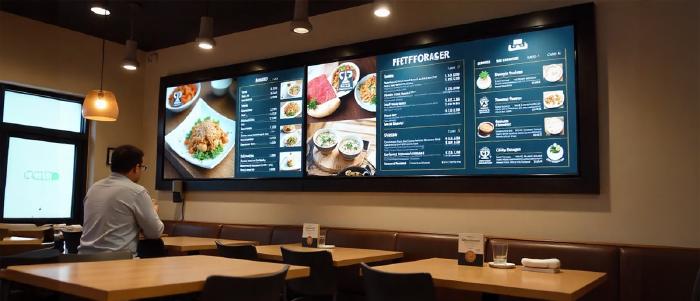
For many businesses, the hesitation around digital menu boards isn’t design. It’s the fear of higher costs and added operational complexity.
One section of the users stick to chalkboards and print because they’re simple, reliable, and the cost feels controlled.

The other side upgrades once, sees how fast they can push price changes, promos, and daypart menus across screens, and they don’t go back because the old way suddenly feels slow, inconsistent, and labour-heavy.

Source: Reddit
The problem is that most teams budget digital menu boards like they’re buying screens.
In 2026, businesses will need to budget a four-layer system that will hold up under real store conditions:
screen layer (commercial display specs and visibility),
compute layer (digital signage player or SoC decisions),
CMS layer (scheduling, permissions, monitoring),
store ops layer (how pricing, availability, and updates actually move, including POS and inventory integration).
Post this, a weekly operating price is enough to keep the system accurate, online, and manageable.
Costs usually rise for the same reasons across most digital menu board projects:
Infrastructure: power, cabling, mounting, networking, and the fact that every site has exceptions
Content ops: digital signage templates, refresh cycles, promotions, and the work required to keep menus current and persuasive
Reliability: offline behavior, downtime exposure during rush hours, warranty strategy, and replacement cadence
Governance: roles, approvals, audit trails, licensing terms, and compliance/permitting that surfaces as you scale
In practice, these gaps manifest as small decisions that compound over time, such as adding an extra screen mid-rollout, adjusting layouts store by store, routing every update through approvals, or reacting to screen failures during peak hours instead of preventing them.
And the hidden categories that teams under-model are consistent: electrical and cabling, installation complexity, content production and refresh cycles, support burden and truck rolls, licensing and compliance exposure.
Hardware choices most directly change your support load and replacement cadence once the boards are live.
| Area | Guidance |
|---|---|
| Duty cycle and heat handling | |
| Static menus and burn-in | |
| Indoor readability | |
| Outdoor/drive-thru | |
| Mounting and structure | |
| Warranty and spares | |
| Procurement rules (fast decisions) |

If you want to keep the hardware decisions above from turning into support headaches later, it helps to pair them with a digital signage software solution that’s built to run across mixed setups, not just one “ideal” device type.
Pickcel supports interactive kiosk-style deployments (touchscreen kiosks, iPad kiosks, touchless QR-led experiences, multitouch video walls, and sensor-driven displays) and is designed to run across common player types and operating systems (for example, Windows, Android, ChromeOS, Linux, Raspberry Pi).
A brief architecture review now prevents avoidable rework once rollout starts.
Pickcel also lays out practical options between external media players for non-smart displays and smart/SoC screens that can run signage apps directly.
This is where long-term stability, support load, and replacement cadence are set. Not by theory. By what happens after month six.
External players keep computing modular. If the player fails or becomes obsolete, you replace the player, not the display. This is usually the safer path for multi-screen setups and longer lifecycles.
SoC displays reduce cabling and simplify installs, but the compute lifecycle can be shorter than the panel lifecycle. If the embedded board can’t keep up with software/security needs, the “replacement unit” becomes the whole screen.
External players preserve the flexibility to change CMS platforms or standards without replacing displays.
SoC deployments can create ecosystem dependency. If you outgrow it, you end up adding external players later or replacing hardware earlier than planned.
Cloud-managed CMS is the default for multi-location operations, offering centralized publishing, dayparting, role-based controls, and real-time device visibility.
On-premise digital signage is still used where data must remain local, but it shifts more operational responsibility in-house and changes the long-term cost and scalability trade-offs compared to cloud-managed signage.
Offline playback should be expected. Content must keep running during connectivity drops.
Architecture should support local caching on the player with predictable behavior during network loss.
Network decisions matter: Wi-Fi can work, but wired Ethernet reduces instability and improves consistency for updates and monitoring.
Prefer players and setups that support auto-recovery for freezes and simple remote remediation.
Remote health checks should support fast triage without relying on store staff beyond basic power/network confirmation.
Scheduled reboots are useful in harsher environments when they’re controlled and don’t interfere with operating hours.
Use SSO and audit logs where governance matters (pricing, brand, approvals).
Lock devices into kiosk policies so the screen stays a screen, not a general-purpose computer.
Isolate signage traffic from POS and other critical systems using a dedicated network segment/VLAN approach.

Implementation insight:
Once reliability and security requirements are clear, it helps to benchmark at least one platform that already supports them without extra glue.
Pickcel covers this baseline with remote health visibility, scheduled restarts on supported players, role-based access with audit logs, and kiosk lockdown on Android deployments. It also fits cleanly into VLAN or dedicated-network setups defined by IT, keeping signage isolated from POS when needed
Define power, network, mounting, and access at the same time you lock hardware. These four variables decide whether installs stay predictable or turn into rework during rollout.
| Area | Guidance |
|---|---|
| Site survey | |
| Electrical | |
| Network | |
| Installation labor | |
| Documentation |

CMS controls exist to keep menu changes accurate across locations, eliminate manual updates, and prevent wrong-menu incidents without increasing support effort
Dayparting and rule-based scheduling to remove manual changeovers: Use dayparting and rules to transition menus automatically, so breakfast-to-lunch changes don’t depend on someone remembering to publish at the right time.
Template systems with locked brand zones to prevent accidental breakage: Use templates with locked brand elements so layouts stay consistent, while allowing controlled price/item edits without breaking the design.
Role-based access to separate governance from store edits: Use role-based access so HQ can govern brand and structure while stores can make scoped updates, without creating an approvals bottleneck.
Health monitoring and alerts for fast issue detection: Use device health dashboards and alerts to catch offline screens/players before stores escalate.
Proof-of-play and screen verification to confirm execution: Use proof-of-play and screen verification to confirm promos are live without calling sites.
Remote actions to resolve basic issues without site visits: Use remote restarts, basic remediation, and controlled update windows so common issues don’t become onsite work.
Structured menu data to reduce labor and error rate: Use structured fields (items, prices, modifiers), so updates don’t require rebuilding assets each time.
Bulk publishing with location-level overrides to scale cleanly: Use bulk updates to keep national consistency, and location overrides where stores legitimately differ.
Flat images only when change is low: Flat-image workflows can work for low-change menus, but costs rise fast once changes become frequent.
Simple price pulls are usually manageable: Basic integration that pulls numeric price values is usually straightforward. Costs escalate with logic, combos, modifiers, taxes, and availability rules: Complex logic (combos, modifiers, taxes, “86ing” tied to inventory) is where integrations become expensive.
Avoid custom sync without an ownership plan: Custom integrations without ownership for POS/API changes turn into recurring firefighting.
SaaS as predictable spend with ongoing updates: SaaS is predictable spend with ongoing updates, security patches, and remote ops features.
Perpetual shifts responsibility in-house: Perpetual shifts upgrades, security posture, compatibility, and future integrations to internal teams.
Dead-end risk is the practical failure mode: The practical risk isn’t the payment model; it’s ending up on a version you can’t evolve without replatforming.

How to Create Beautiful Digital Menu Board with Pickcel Digital Signage?
Menu boards get expensive when changes are frequent, and the workflow isn’t built for speed, control, and verification.
Treat change velocity as an operating input: Price updates, LTOs, and availability changes are routine. Budget impact depends on whether each change is a quick field edit or a designer-driven rebuild.
Set ownership so updates don’t stall: Define who can edit what, who approves what, and what must be verified. Role-based approval chains keep routine changes moving while preventing accidental brand or pricing edits across locations.
Use a design system that absorbs routine changes: Standardize templates and lock the parts that shouldn’t change. This reduces agency dependency and prevents layout breakage during fast updates.
Prefer structured updates over asset rebuilds: Structured fields (items, prices, modifiers) keep updates fast and consistent. Flat images are fine only when the Prefer structured updates over asset rebuilds: Structured fields (items, prices, modifiers) keep updates fast and consistent. Flat images are fine only when the change frequency is low; otherwise, every change turns into an export-upload cycle.
Accuracy is a cost line, not a nice-to-have: Incorrect prices, missing items, and stale offers create immediate operational noise. A clear content governance policy prevents ad-hoc edits and makes it obvious what “correct” means for pricing and compliance fields.
Permits and compliance should be budgeted as a scoped workstream, not treated as “part of installation.”
For exterior and drive-thru screens especially, line-item the permit package per location (sign/zoning, structural, electrical, as applicable), plus any required drawings, engineer stamps, resubmittals, and inspection coordination. Also account for mandated licensed sign contractors where required, and any compliance-driven hardware adjustments (brightness controls, mounting changes, enclosure changes).
Operationally, assign clear ownership for submissions, installer coordination, inspections, and close-out documentation, and hold a small reserve for rework and permit delays that trigger crew re-mobilization. Maintain a per-site compliance file (approved permits, stamped plans if used, inspection sign-offs, and as-builts) so future remodels, renewals, and multi-city expansion don’t recreate the same cost.
| Area | Guidance |
|---|---|
| Preventive maintenance that matches the environment | |
| Downtime prevention | |
| Store SOPs that stop unnecessary escalations | |
| Monitoring that prevents truck rolls | |
| Governance that prevents “fixes” from causing new problems |
If you take one thing from this guide, it’s this: digital menu board cost spirals aren’t caused by one bad purchase. They come from treating a multi-layer system like a screen order.
The teams that stay on budget model the full lifecycle early, then make decisions that reduce repeat work: reliable hardware fit for the environment, a compute layer that’s serviceable, software that supports fast controlled change, and infrastructure that’s specified per site instead of assumed.
A defensible plan is simple to communicate internally: separate CapEx, OpEx, and risk reserves.
Choose a 3-year or 5-year digital menu board TCO window that matches your refresh reality.
Be explicit about what scales with screen count and update frequency.
Validate in a pilot what matters operationally: offline behavior, remote monitoring and verification, update velocity, and how quickly a bad publish can be rolled back.
If those are solid, the rest of the rollout becomes repeatable.
From here, the practical step is documenting your own constraints in one place: screen mix (indoor vs drive-thru), update cadence, POS dependency, uptime tolerance, and who owns day-to-day changes. That clarity is what makes architecture, budgets, and rollout trade-offs predictable.
Pickcel is trusted by global brands across industries, and our team brings more than a decade of hands-on digital signage experience.
If you’re planning a digital menu board rollout, we can help you upgrade the in-store menu experience while keeping the setup practical, scalable, and manageable for day-to-day operations.
Connect with our team of experts.
Costs rise mainly due to price creep, where overlooked factors add 15–20% post-purchase. Common drivers include under-spec’d consumer displays failing in heat, expanding POS integration scope, stricter signage regulations, and site-specific infrastructure gaps like power, cabling, and mounting discovered during installation.
Hidden costs include electrical work, network drops, permits, ongoing software licenses, energy consumption, routine maintenance, and content operations. These often represent 20–30% of annual spend and scale with update frequency, compliance needs, and site variance rather than just screen count.
Budget using a full TCO lens: separate CapEx, OpEx, and risk reserves. Run early site surveys, spec commercial-grade hardware, pilot before scaling, and choose a 3- or 5-year lifecycle aligned with refresh reality. Validate offline behavior, monitoring, and rollback before rollout.
Most digital menu board deployments break even within 9–18 months. ROI comes from eliminating print labor (up to 95% savings for frequent changes) and improving merchandising, which typically drives 3–12% overall sales lift, with higher gains on promoted, high-margin items.
Aug 18 2025
8 min read
Mar 10 2025
8 min read

Dec 4 2024
7 min read
Dec 4 2024
7 min read
Take complete control of what you show on your digital signage & how you show it.
Start Free Trial Schedule My Demo