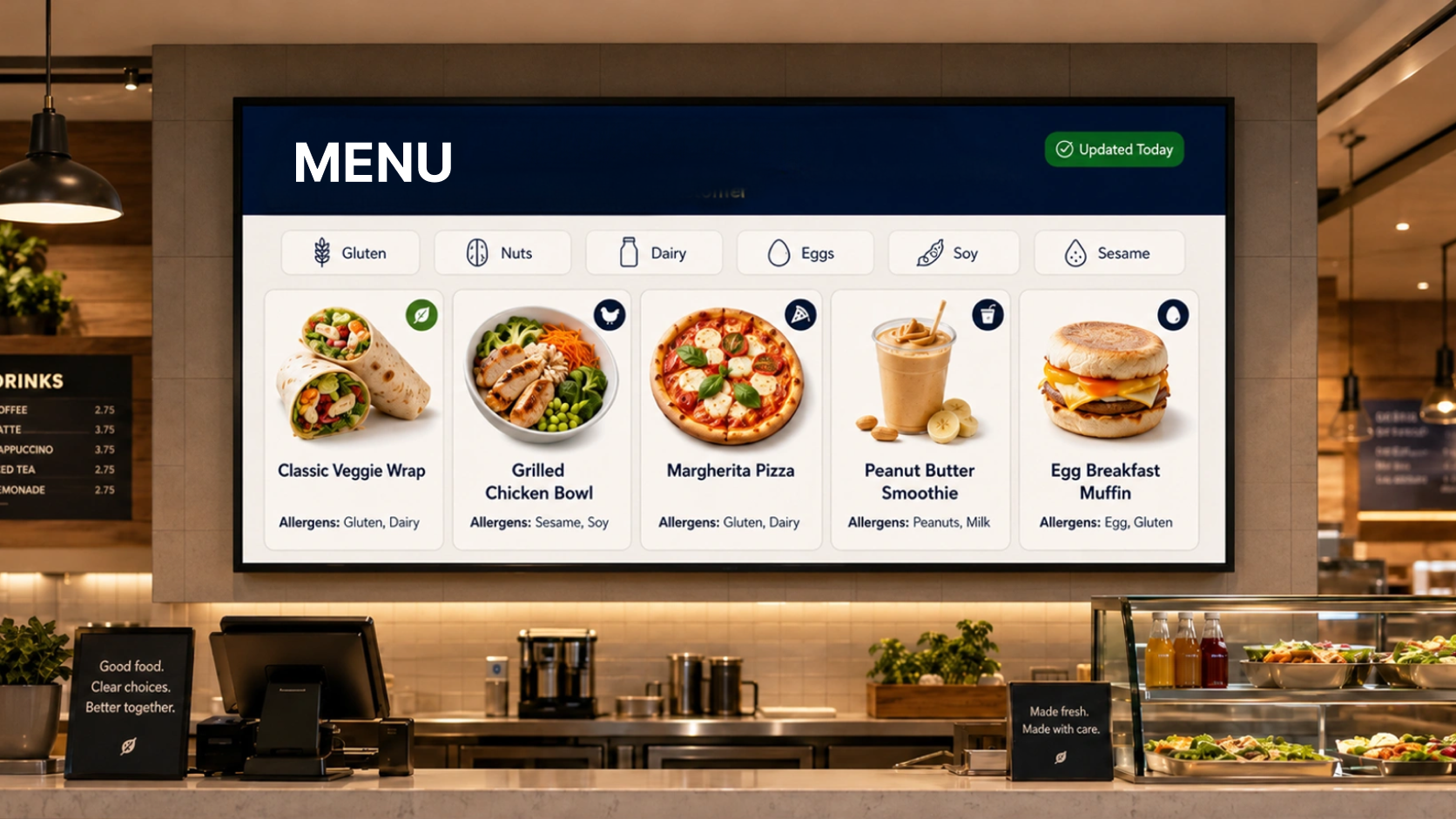
Allergen labelling is a legal obligation in most markets. For a restaurant operator managing dozens of locations, keeping every screen accurate as menus change is both operationally critical and technically difficult. A new supplier, a reformulated sauce, a seasonal special: each change has the potential to invalidate allergen information that customers are relying on when they order.
Printed menu boards cannot keep pace with the rate of menu change. By the time updated materials reach every location, some boards will still carry the old information. Digital menu boards managed through a centralised content management system address this at the update layer: one change, all screens, immediately.
This guide covers the regulatory context for allergen disclosure, how digital menu boards address the compliance challenge, and how to structure allergen information on-screen for accuracy and readability.
- UK Natasha's Law and EU FIC mandate 14-allergen disclosure.
- A central CMS eliminates the update lag printed allergen boards create.
- Use allergen icons and text labels; test readability at viewing distance.
What Is Allergen Information on a Digital Menu Board?
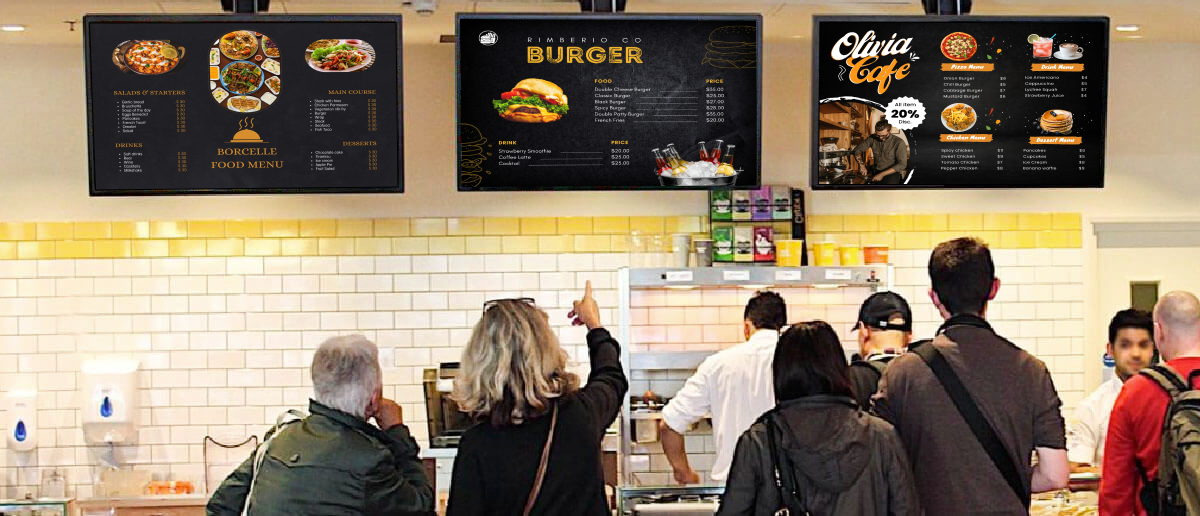
Allergen information on a digital menu board is the real-time display of food allergen data alongside menu items, delivered through a centrally managed digital signage system. Instead of static printed boards or laminated cards, digital systems allow operators to update allergen details across every screen at every location simultaneously from a single content management system. This ensures customers receive accurate, current allergen information at the point of ordering rather than outdated printed versions that reflect an earlier menu state.
Allergen Disclosure Requirements for Restaurants
Allergen law in the UK and EU places clear obligations on food service operators, but the specific requirements differ by food type and jurisdiction.
UK regulatory framework
In the UK, allergen disclosure for food businesses is governed by the Food Information Regulations 2014, which retained the requirements of the EU Food Information to Consumers (FIC) Regulation No. 1169/2011 after Brexit. For non-prepacked food served at restaurants, cafes, and catering operations, the regulations require that allergen information is available to customers upon request and that customers are clearly informed how they can obtain it. Many operators satisfy this through menus, screen displays, or table cards. For cafe operators specifically, meeting that request-and-disclose standard is simpler on a screen than on laminated table cards, since a cafe digital menu board with built-in allergen disclosure can surface the same 14-allergen information at every till and table without printing a new card every time a recipe or supplier changes. That single-source approach also gives cafes the same audit trail regulators expect from larger multi-site restaurant chains.
Natasha’s Law (the Food Information (Amendment) (England) Regulations 2021, effective October 2021) addressed a specific gap in the prior rules: prepacked for direct sale (PPDS) food. PPDS food is prepared on the premises and packaged for display before the point of sale, such as a wrapped sandwich at a counter. From October 2021, PPDS food must carry a full ingredient list with the 14 major allergens clearly highlighted.
The Food Standards Agency (FSA) publishes detailed guidance on allergen labelling obligations for food businesses at food.gov.uk.
EU regulatory framework
In the EU, the primary legislation is EU Regulation No. 1169/2011 on the provision of food information to consumers. The allergen disclosure requirements are equivalent to those in the UK framework: the same 14 major allergens apply, and the same obligation to provide information about non-prepacked food to customers upon request exists across EU member states.
The 14 major allergens
Under both UK and EU frameworks, the 14 major allergens that must be disclosed are:
- Cereals containing gluten (including wheat, rye, barley, oats, spelt, and kamut)
- Crustaceans (including prawns, crab, and lobster)
- Eggs
- Fish
- Peanuts
- Soybeans
- Milk (including lactose)
- Nuts (almonds, hazelnuts, walnuts, cashews, pecan nuts, Brazil nuts, pistachio nuts, and macadamia nuts)
- Celery
- Mustard
- Sesame seeds
- Sulphur dioxide and sulphites (at concentrations above 10 mg/kg or 10 mg/L expressed as SO2)
- Lupin
- Molluscs (including mussels, oysters, squid, and snails)
Source: Annex II, EU Regulation No. 1169/2011; UK Food Information Regulations 2014. Verify current requirements at food.gov.uk and EUR-Lex.
Other markets
Similar allergen disclosure requirements exist in Australia and New Zealand (Australia New Zealand Food Standards Code, Standard 1.2.3), Canada (Safe Food for Canadians Regulations), and the United States (Food Allergen Labeling and Consumer Protection Act 2004, as amended by the FASTER Act of 2021 which added sesame as a ninth major allergen from January 2023).
For context on digital menu boards and how they are typically deployed in food service environments, the 101 guide to digital menu boards covers the operational fundamentals.
Important disclaimer: Requirements vary by market, food category, and service type. This article provides an overview only. Always verify current requirements for your specific jurisdiction with your legal team or food safety advisor before making compliance decisions.
How Digital Menu Boards Support Allergen Compliance
The core compliance risk with printed allergen information is the time gap between an ingredient change and its reflection on every board at every location. A reformulated dish, a new supplier, a temporary substitution: in a multi-location operation, that change has to be communicated to each site, printed, and physically replaced. During that interval, some locations will carry outdated information.
Food operators report that digital menu boards significantly reduce the risk of displaying outdated allergen information compared to printed materials that require manual redistribution across all locations.
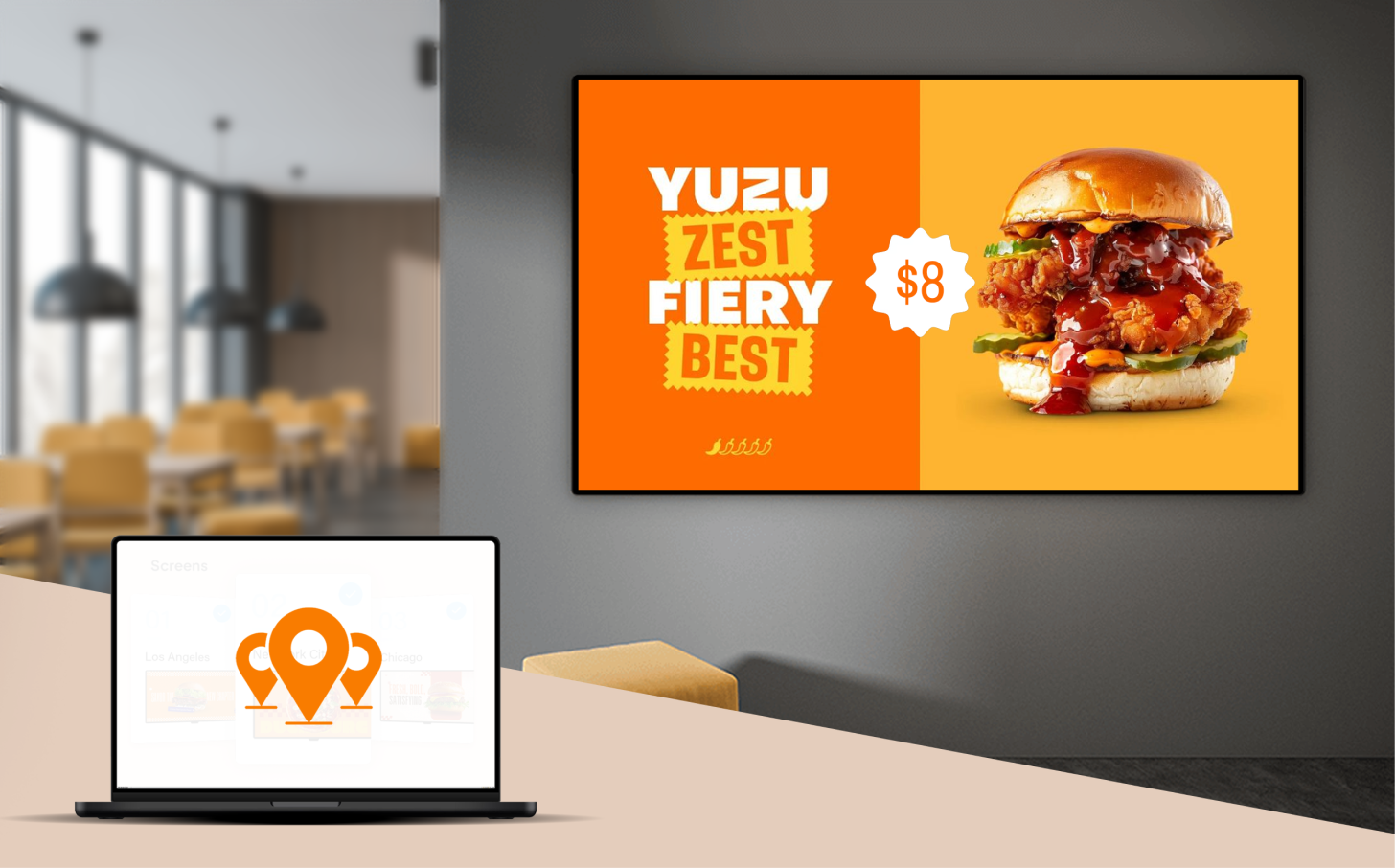
One update, all screens, simultaneously. When allergen information changes, the content manager makes a single update in the CMS. That change is pushed to every screen at every location in real time. There is no distribution lag. There is no risk of some locations running a previous version while the updated materials are in transit.
A single source of truth. All allergen data lives in one place. There is no local version at each location to diverge from the central record. Every screen reflects exactly what the CMS holds at any given moment.
Version control and audit trail. A CMS logs every content change: what was modified, who made the change, and when. This operational record documents that allergen information was current at any given point in time, which is relevant in the event of a compliance review.
Immediate corrections. If an ingredient change is identified after content has been published, the correction reaches every screen through the same workflow as the original update. There is no need to recall and replace printed materials across dozens of locations.
Multi-location consistency. Whether a business operates 5 locations or 500, the CMS update workflow is identical. Compliance overhead does not grow with location count.
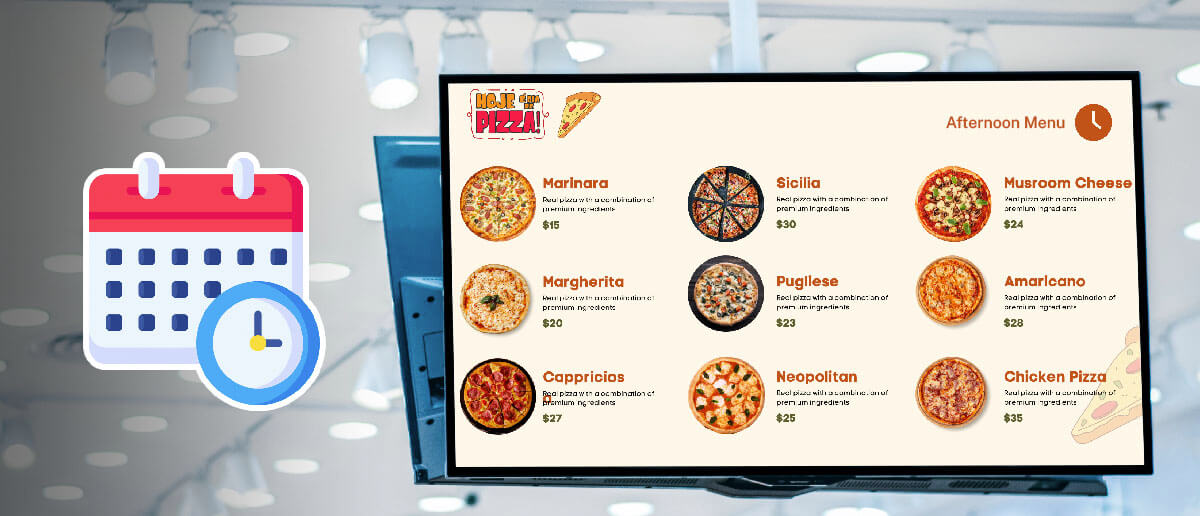
Pickcel’s digital signage software supports this workflow with role-based access control, ensuring only authorised users can modify allergen-related content. Content scheduling allows planned menu and allergen updates to take effect at a specified date and time without manual intervention at each location. For organisations with data security requirements, Pickcel holds SOC 2 Type II and ISO 27001 certifications, covering the data integrity processes relevant to content management.
See how Pickcel manages allergen content updates
If you want to see how Pickcel manages allergen content updates across multiple locations, request a demo for a walkthrough of the CMS workflow.
How to Display Allergen Information on a Digital Menu Board
How allergen information appears on screen determines whether customers can act on it. Font size, icon usage, placement, and dwell time each affect whether a board communicates clearly or creates confusion at the moment of ordering.
Icons versus text. Allergen icons (standardised symbols for gluten, nuts, dairy, and other categories) support at-a-glance recognition in busy environments. Text labels carry meaning without prior knowledge of symbol conventions. The recommended approach is both: use the icon for quick scanning and the allergen name written alongside. Do not rely on icons alone.
Placement relative to menu items. Allergen information must be directly associated with the corresponding dish. Presenting a separate allergen chart on a secondary screen or in a different zone of the board requires customers to cross-reference two displays at the point of ordering. That creates friction and the potential for error.
Colour coding. Colour can reinforce allergen categories but must not be the sole differentiator. A meaningful proportion of the population has difficulty distinguishing certain colour pairs. Colour supplements text labels; it does not replace them.
Readability at distance. A digital menu board is typically read from 2 to 5 metres. Allergen text must be legible at that distance. Test font size, contrast, and layout in the actual installation environment before finalising.
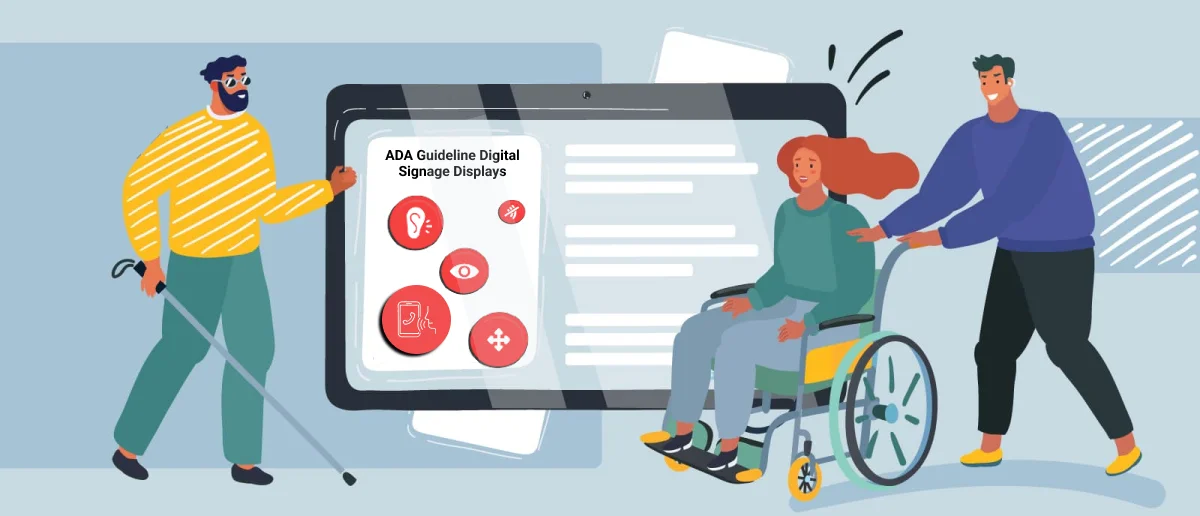
For ADA requirements for digital displays and broader accessibility standards affecting on-screen readability, Pickcel’s guide covers contrast ratios, minimum font sizes, and colour-coding recommendations in detail.
Dwell time for animated content. If the menu board uses transitions or content rotations, allergen information must remain on-screen long enough to read fully at viewing distance. Do not place allergen details in a slide that rotates off before a customer can read it.
Last-updated indicator. Consider displaying a last-updated date on the allergen section of the board. This gives customers and food safety inspectors visible confirmation that the information is being actively maintained.
A well-structured allergen display serves the customer and the operator: it communicates clearly to the person ordering, and it demonstrates due diligence in the event of an inspection or incident review.
Frequently Asked Questions
What is allergen information on a digital menu board?
Are restaurants legally required to display allergen information on digital menu boards?
How does Pickcel help restaurants display accurate allergen information across multiple locations?
Can digital menu boards automatically update allergen information when a recipe changes?
What are the 14 major allergens that restaurants must disclose under UK and EU food law?
See how Pickcel handles allergen updates across your locations
If you want to see how Pickcel handles allergen updates across a multi-location estate, the product overview has the full detail. The demo request takes about two minutes.