

Dec 24 2025

10 min read
November 26, 2025
7 min read


ALL
GENERAL

AV integrators are operating in a market where hardware margins keep shrinking, and clients now expect unified AV, signage, and content experiences delivered with consistency across every site.
IT alignment and site prep get addressed too late, creating avoidable delays.
Hardware, CMS mismatches lead to playback issues or forced changes mid-project.
Network gaps and no monitoring turn into black screens and surprise support calls.
Limited user training sends basic publishing tasks back to your team.
These challenges aren’t new to AV teams, but they directly influence whether signage becomes a profitable service line or an operational burden. Which is exactly why the digital signage partner you choose matters more than the hardware on the wall.
The right partner strengthens your delivery,
protects your margins,
and helps you scale with confidence.
Who This Is For:
AV integrators and technical leads who want a clear, practical way to choose a digital signage partner that strengthens delivery, reduces support issues, and helps them win bigger, more profitable projects.
| Evaluation Area | What You’re Really Evaluating |
|---|---|
| CMS Fit & Operational Load | Will clients run this independently, or will your team be responsible for providing daily support? |
| Content Workflow & CaaS Potential | Does the CMS minimize client friction, reduce ad-hoc requests to you, and open a path for recurring content revenue instead of recurring support pain? |
| Scalability Without Process Drift | Can the partner maintain consistent deployment across 10, 100, and 1000 screens without reinventing the wheel each time? |
| Hardware Flexibility (No Lock-In) | Can you reuse client hardware, avoid forced ecosystems, and keep project budgets realistic? |
| Integration Readiness | Does the CMS cleanly connect with POS, BI, ERP, CRM, or APIs without custom patchwork? |
| Deployment Choice | Confirm whether the provider supports cloud, hybrid, and on-premise digital signage software. This matters if you have strict IT policies, separate networks, or compliance requirements. |
| Monitoring & Uptime Stack | Will remote actions and real diagnostics meaningfully reduce truck rolls and protect SLAs? |
| Security & Access Control | Review how the platform handles authentication, user roles, audit logs, and basic digital signage security expectations. |
| Support Model | Will the signage partner absorb ongoing support or push everything back to you? |
| Business Alignment & Margin Impact | Does this partnership expand your recurring revenue (licenses, managed services)? |
To ground these criteria in something concrete, here are a few Pickcel capabilities that show what good execution looks like in practice.

Monitoring & Uptime: Health visibility, alerts, and remote actions reduce the amount of manual checking your team needs to do across locations.

Integration Readiness: Straightforward APIs and connectors simplify pulling data from POS, Power BI, dashboards, or internal platforms, useful if you want automated content and fewer manual updates.

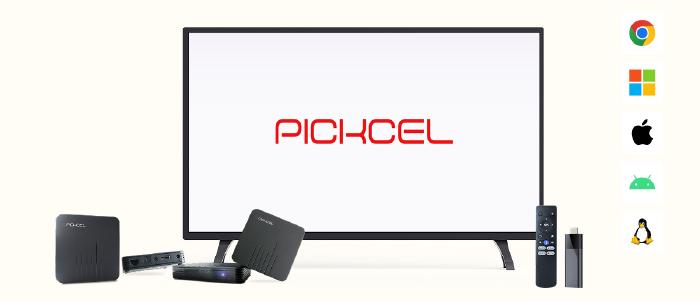
Hardware Flexibility: Runs on nearly any digital signage player or display you already use, without forcing a particular device family or upgrade cycle.
These are the models that genuinely drive growth for AV integrators without the typical operational overhead.
Reseller licensing: A simple, predictable model where you sell CMS licenses and keep the margin on annual renewals. Works when the software is stable, light on support, and doesn’t trigger daily client questions that eat into your time.
White-label CMS: You present the platform under your own brand, set pricing, and own the client relationship. This is viable only when the vendor supports full rebranding, open standards, clean data portability, and no hardware lock-in; otherwise, the “white-label” becomes another dependency.
Managed signage services: Two service lines continue to deliver positive unit economics across deployments:
Monitoring-as-a-service: Remote actions, health alerts, diagnostics, and uptime reporting that cut truck rolls and allow you to sell guaranteed SLAs.
Content-as-a-service: Clients outsource updates, scheduling, dayparting, and creative work. This becomes a steady monthly revenue line, especially in retail, QSR, corporate communication, and healthcare.
Pickcel is built for the real-world environments AV teams deliver every day. Some of the globally recognized hardware brands we integrate with include BrightSign, Philips, LG, Samsung, Toshiba, NEC, and Qbic.
Custom firmware and player-level optimizations for stable playback
Performance-tuned builds across SoC and dedicated players
Continuous updates without adding load to your team
Clean API layer for POS, BI, ERP, CRM, sensors, and IoT workflows, reducing custom work and accelerating deployments.
Pickcel provides the reliability, compatibility, and engineering maturity needed to support enterprise environments without increasing your support burden.
Become a PartnerScreen networks are expanding fast, and the partner you choose will either support that scale or slow it down. The list below gives you a quick, practical way to separate risk from reliability.
| Red Flags | What Strong DS Partners Demonstrate |
|---|---|
| Forced hardware or closed ecosystems. | Hardware-agnostic support across mixed fleets. |
| No advance IT/network documentation. | Clear network specs + pre-configured players ready for install. |
| Weak monitoring or no remote actions. | Health visibility, alerts, and reliable remote remediation. |
| Heavy CMS that slows users down. | Fast, intuitive workflows that non-technical teams can run independently. |
| Unclear SLAs or slow escalation paths. | Defined response times, clear ownership, predictable escalation. |
| No on-prem or hybrid option. | Flexible deployment (cloud, hybrid, on-prem) depending on IT policy. |
| No multi-site rollout experience. | Repeatable processes, consistent commissioning, and multi-location readiness. |
| Limited integration capabilities. | Clean API connectors for POS, BI, ERP, CRM, and IoT workflows. |
For a dependable digital signage partner, Pickcel stands out as one of the leading players in the space, trusted by global brands across industries and backed by a team with over a decade of experience and expertise.
For teams building or scaling their signage infrastructure, our experts can help you validate the right approach for your environment, eliminate avoidable risks, and design a network that stays reliable at scale.
Check CMS usability, hardware flexibility, monitoring depth, and integration readiness. If it reduces operational load, works across mixed fleets, and supports scalable rollouts without custom patchwork, it fits. If any pillar breaks, move on.
Choose CMS platforms that support multiple OS types, open standards, clean data export, and non-proprietary players. Avoid partners who restrict hardware choices or require unique formats. Hardware-agnostic systems keep future migrations and upgrades safe.
Choose platforms that run on multiple OS types, support open standards, and don’t force proprietary players. Confirm that all content, data, and users can be exported without penalties or special tools.
Look for clear uptime reporting, remote actions, predictable SLAs, and a single accountable contact. Avoid partners who rely on ad-hoc troubleshooting or don’t offer proactive monitoring.

Dec 24 2025
10 min read

Dec 9 2025
14 min read
Nov 7 2025
11 min read
Oct 30 2025
8 min read
Take complete control of what you show on your digital signage & how you show it.
Start Free Trial Schedule My Demo